|
Black Bears |
|
|
|||
|
Ursus americanus |
||||||
|
Black Bears |
|
|
|||
|
Ursus americanus |
||||||
|
|
|
|
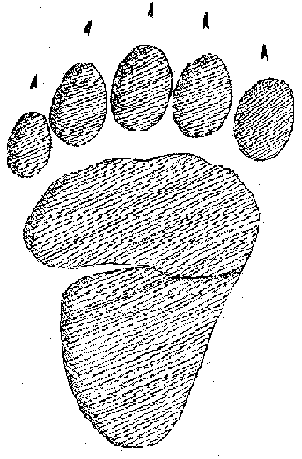
5 in. L X 5 in. W |
7 in L X 5 in. W |
|
Right Front Foot |
Right Hind Foot |
|
Black Bear Tracks |
|
|
Front track on the left. Hind track on the right. Claw marks do not always show. |
|
|
|
|
 |
|
|
|
|
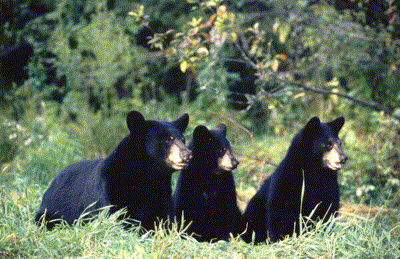 |
Black bears are the smallest American
bears, and the most common. They are the only
bears found in the wild in California. Although
the grizzly bear is the state mammal, it has
been extinct in California since 1922.
Black bears are usually nocturnal, but can be active during the day. Bears are strong, agile, and quick. They swim and climb trees well. A bear can run 30 miles per hour in short bursts.
|
| Bears eat a wide variety of foods. A partial list includes: grass, leaves, nuts, berries, buds, twigs, roots, corn, fruits, insects, plant sprouts, invertebrates, fish, carrion, fruit, succulent plants, eggs, birds, small mammals, and human garbage. Bears will dig up underground wasp nests to eat the insects, nest and all. They are extremely hungry when they emerge from their winter dormancy period in the spring and will often strip the bark off trees to eat the sugary cambium layer. The bears in my region do not hibernate all winter, but they do sleep away the harshest part of winter. Bears den in logs, beneath fallen trees, and in caves. Several days before entering the den, a bear consumes roughage, including leaves and bits of its own hair. These form a plug up to a foot long in the digestive system that is voided after the bear emerges from the den. | |
| One or two young are
born during the winter, usually in late January
or
early February. They weigh ½ pound at
birth (about as much as a can of soda or a stick
of butter) and grow quickly by nursing on the
mother's milk, which can contain as much as 20%
fat.
Bear droppings are over an inch thick, and tubular. The scat varies with diet, which can be 90% vegetable matter. Bears are shy animals and will usually run from humans. They sometimes raid human garbage, compost piles, or pet food dishes that are left outside. The inner toe in the track is
the smallest toe. Bears walk plantigrade or
flat-footed. In some places, bears use the
same trails over and over for generations.
They tend to place their feet in exactly the
same place every time they use the trail. You
can find these trails where each footfall is
in a depression worn into the ground by the
passage of so many bears over the years. I
once found one of these trails that was over
two miles long! They also make "ritual trails"
or stomp marking trails near their marking
trees. See pages blow for more information on
this. The stride is about 36 to 42 in. The most common walking trail pattern is at right. For such a heavy animal, black bears leave very light impressions in some soil types. I find that dry, dusty soil shows details of the pads of the feet well. Mud shows the toes and claws well, although claw marks are not always found in black bear tracks! Nice damp sand is the best medium for bear tracks, but it's hard to find in some places! |
|
|
Black bear trail pattern |
|
Other Black Bear Pages on this
site: |
| To see black bears in action, marking on trees in their territory and doing other bear things, visit my YouTube channel: |
| The videos on my YouTube channel come from trail cameras I have set up in the woods to show black bears in their natural habitat, doing what they do when no one is watching. Enjoy! |
|
Not hosted on
this site, but great black bear page |
|
Black Bear Tracks and Sign Photos |
|
|
|
|
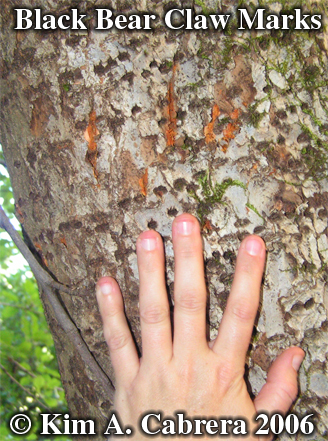
| The two photos above show the claw marks left by a black bear on an apple tree. In late summer, when the apples are ripening, the bears use them as a food source. There are many old abandoned orchards in my area and they provide a regular food source during the right season, just before winter and the scarcity of food that comes with it. To determine which animal left the claw marks, count the number of claw marks. Five is usually bear, but they don't always leave all five! So be careful when trying to make an identification. Use all the clues available. Ask yourself why the animal would climb the tree? For food, shelter, to hide from a predator? The sharpness of the claws will also help. Cats have narrow, sharp claws. Bears' claws are not as sharp. Cats (i.e. bobcats and cougars) also have a fifth toe, with a claw, located on the wrist. This can leave a mark when they climb. Blunt claw marks are usually left by bears, and frequently left on fruit trees. | |
|
|
|
|
Black bear hind track. The longer heel will sometimes show in the hind prints. Not always though, so be careful in your identification. Look closely at the gait as well as the placement of the feet. This will help you tell front from hind tracks. Notice the lack of claw marks on these tracks. Black bear tracks do not always show their claws. This particular track shows some fur marks at the lower left of the photo. |
|
 |
|
|
Hind track of a black bear. The longer heel will sometimes show in the hind prints. Not always though, so be careful in your identification. Look closely at the gait as well as the placement of the feet. This will help you tell front from hind tracks. Notice the lack of claw marks on these tracks. Black bear tracks do not always show their claws. |
|
|
|
|
|
A hind bear track on a dusty dirt road. |
|
|
|
|
| The right hind track of a black bear in dust. I tracked this bear down a dirt road, through the tall grass to a pond, where he deposited a large scat. Then the bear went cross-country through the brush and ended up at a landfill, where he wandered around for a bit before heading off into the forest. | |
|
|
|
|
A beautiful left front track from a black bear. This fine dust left marks from all five toes, as well as the fur from the bear's foot! |
|
|
|
|
| A left hind black bear track. This one shows some ripples in the heel pad. This could indicate an older bear. These hind tracks were eight inches long, making it definitely an adult bear. | |
|
|
|
|
The tiny track of a black bear cub found in the mud of a dried-up pond. This little footprint is less than three inches wide! A very nice find. Cubs are lighter in weight, so don't tend to leave really distinctive tracks in most soil types. |
|
|
|
|
|
The left hind track of a black bear in dust. In dust, the claw marks are often unclear, or not really visible. |
|
|
|
|
| This apple orchard had numerous signs of bear activity. Most of the trees had scratch marks in the bark from bear claws. There were plenty of scats all around. The grass around the trees had been flattened down by bears walking on it. Many of the trees also had broken or bent branches. Bears, in their feeding activity, will bend the fruit-laden branches toward themselves to get at the fruit. They often break branches this way. Their large size will also break some branches. But that's OK with the bear. It just goes down to the ground and picks up the fruit and eats it! | |
|
|
|
| This apple tree had bear claw marks of various ages. Apple trees can live for over 100 years and bears use them for food each year. In my area, there are many abandoned orchards which support a lot of wildlife, including bears, foxes, raccoons, deer, and coyotes, to name a few. Bears climb the apple trees to get at the fruit. There were also bear hairs snagged in the bark of the trees in this orchard, another clue as to the culprit who ate the apples! | |
|
|
|
| A nice cast from a footprint left in deep mud. The details, such as the fur on the side of the foot, are even visible here. | |
|
|
|
| Bear scat made up of mostly seeds and berries. There are also a few wasp exoskeletons in the one on the right. Bears love to dig up the wasp nests and eat them. These scats are loose and formless due to the moisture content of the diet. | |
|
|
|
|
Another fairly formless scat due to the bear's moist duet of berries. |
|
|
|
|
| Two bear scats composed of grass and vegetation. These were found in early spring, before many plants were ripened and no fruits were available as a food source. Many animals have diets that change seasonally as the availability of certain foods changes. | |
|
|
|
|
This bear scat is more firm and holds its shape. The diet here was drier than the berry diet above. |
|
 |
|
|
Bear scat composed of blackberry seeds. Often, you will find purple juice running downhill from these scats. Look to the top of the photo to see this. Bears eat a lot of berries! |
|
 |
|
| Close-up of portion of black bear scat above showing round cross-section and diameter. | |
 |
|
|
A nice hind track in fine dust. This bear did not leave any claw imprints. |
|
|
|
|
| A pair of bear tracks in river sand. These tracks have been worn by the wind until they are mere depressions. However, you can still make out the distinctive shape of the footprints. The hind foot, on the right, shows nice definition of the toes. Ruler is 12 inches long. | |
|
Bears Getting Into Trouble |
|
|
|
|
| The lid of a dumpster raided by a bear. The bear got up on top and managed to bend the plastic lid to get at the tasty garbage inside. Notice the black garbage bag on the ground in the background. The smudges on top of the lid were caused by the bear. Although the heavy metal bar was across both lids, this didn't stop the bear. They are quite strong. | |
 |
|
| This plastic
jelly jar was removed from the dumpster above by
the bear. It was completely licked clean after
it was gnawed open. I heard something making a
crunching sound in the brush, but it was dark
outside and I couldn't see the culprit. I
grabbed a strong flashlight and air horn and
returned. The bear heard me coming and meandered
out of the brush. One blast of the air horn was
enough to convince it to leave. I found this jar
and some other garbage the next day, during
daylight hours. The air horn was very effective
in scaring it off. I found its tracks once more
near the dumpsters that summer, but not since. I
also had the dumpsters replaced with more
bear-resistant ones.
|
|
| So, how do you
keep bears out of dumpsters and garbage cans?
First, dumpsters are difficult to secure as
bears are very strong animals. Even a raccoon
can climb atop a dumpster and insert a paw
between the lids in that little crack. They can
pull trash out and make a mess. Bears that get
used to getting into garbage often turn into
problem bears. In many places, this means the
bear will end up getting shot. Once a bear
learns this behavior, it never forgets. So, even
if that bear is trapped and relocated someplace
else, it will likely become a problem in the new
location too. Thus, wildlife managers will often
resort to killing problem bears. This is the
policy in many national parks. The best
way to keep the bears safe is for the humans
who visit their homes to keep their food and
garbage locked up where bears can't get into
it. If you go camping or hiking, use
bear-proof canisters to secure your food. Pack
out all garbage and dispose of it in bear-proof
containers only. When you cook, cook away from
your campsite. Don't sleep in the same clothes
you wore while cooking as there will be cooking
odors in the fabric. Don't dispose of food
scraps by throwing them on the ground. If
possible, burn them in your campfire. Hang your
food from a tree at night. If you are camping in
a car campsite, there should be bear-proof food
storage bins in your campsite. If the park does
not provide them, ask the staff if it is safe to
store food in your vehicle. In some areas, bears
have not learned to get food out of cars yet, so
this would likely be safe. The staff at the park
should be aware of the best way for visitors to
secure their food. In other places, like
Yosemite, bears know how to get food out of
cars, so don't leave anything edible in the car.
This includes scented items like toothpaste.
Even a candy wrapper could attract a bear. Their
noses are highly sensitive!
If you live in bear country, ask your garbage collection service to provide you with bear-resistant containers. The dumpster in the photos above was replaced with one with solid metal lids. It makes it more difficult for people to lift the lids, but it also keeps the bears out fairly well. These dumpsters didn't cost any more than the old ones with plastic lids. You may also be able to obtain more sturdy curbside bins from the collection service. If you know when your bins are picked up, you can place them outside right before that time and thus minimize the time that garbage is outside where a bear could be attracted to it. |
|
|
|
|
|
A black bear that
visited the campsite of a friend of mine.
These are the photos she got. |
|
| The bear above did not exhibit much fear of humans. If a bear does this, it is probably becoming habituated. Once this happens, the bear could become a problem bear, coming into campsites and tearing them apart for food, or getting into garbage. To prevent habituation, make noise, bang pots together, throw rocks at the bear, use an air horn, or use a slingshot and marbles. The idea is to make the bear uncomfortable around people. Don't let the bear become used to being around people and getting food from their campsites. Once a bear learns this behavior, it will probably be killed because they never forget, and the bear will return again and again. Due to the potential for injury to humans, most parks simply kill the problem bear. Save a bear's life by properly storing your food and garbage at all time when in their habitat! Never try to take food from a bear that has raided your campsite, and never approach an aggressive bear. Let it have the food and let the park staff deal with the bear. | |
|
Bear Scat Aging Comparison |
|
|
|
|
|
Fairly fresh bear scat. It was two days old in this photo. |
|
|
|
|
|
Same scat 20 days later. It is beginning to fall apart and lose moisture. |
|
|
|
|
|
The same scat as above in April 2006. This scat is six months old, but it is still recognizable as a bear scat. The large quantity of seeds gives it away. This is way more seeds than you would find in the scat of, say, a coyote. |
|
|
|
|
|
More Bear Scats |
|
|
|
|
|
Black bear scat composed mostly of blackberries and their seeds. Bears feast on these early in summer before other foods are ripe. |
|
 |
|
|
Bear scat with blackberry and cherry pits. |
|
|
|
|
| A large black
bear scat composed entirely of apples. There is
an old abandoned apple orchard near here and the
bears feast on them in late summer. In the lower
left corner is the scat of a gray fox. Foxes
often deposit their scats on top of bear scats.
Perhaps it's a way of marking territory. This
behavior is called overmarking. |
|
 |
|
|
The black bear that deposited this scat had traveled down a dirt road. He then walked off the road to the pond. I found this fresh scat deposited on the edge of the drying-up pond. There were a few plum pits, but this scat was composed mostly of blackberries. Notice the line of purple dye running from the scat and downhill to the right. This is typical of blackberry scats. The juice goes through the digestive tract and leaves a stain under the scat the bear leaves behind. This bear had tracks that were almost 8 inches long. The diet of blackberries is typical of late summer scats. |
|
 |
|
|
The location of the scat deposit above. The pond normally has a lot more water, but this was a dry year and it was slowly drying up. I have never seen the pond this low before. |
|
|
Bear Tracks Compared to Human Tracks |
|
| It has been said that bear tracks resemble human tracks. With that in mind, I thought about making a comparison to my feet. When I found these perfect bear tracks in nice deep dust, I couldn't resist. Off came my shoes and I got my feet (and hands) dirty. Here are the results. Do bear tracks look like human tracks? | |
 |
|
|
|
|
| The two photos above show hind feet of a black bear compared to the "hind" feet of a human. The human track is longer and the toes are not as curved. The bear's heel is narrower. The front part of both feet does show a resemblance. Bears do not always show their claw marks. The heel also does not always leave an imprint. | |
 |
|
| Comparison of a
bear's front foot with a human's "front foot." The resemblance to human feet only seems to apply to the hind feet! :) |
|
 |
|
| The left hind track of a black bear in fine dusty soil. Some claw marks show in this photo. | |
 |
|
| A nice clear left hind track in dusty soil. Notice the marks left by the fur on the bear's foot and arm surrounding the track. | |
 |
|
|
Right hind track in firmer dusty soil |
|
|
|
|
|
|
|
|
(Above and below) Two right front
tracks from the same bear. Claw marks are
visible on some toes. |
|
 |
|
|
The two photos above show the two
right front tracks from the same bear. Claw
marks are visible on some toes. |
|
|
|
|
|
Right hind print - one day old. |
The same right hind print as in the photo at left, but this one is fresh. Notice the crisp edges of the track and the imprints left by fur. By the next day, these are gone, rounded off by wind and gravity. |
|
|
|
|
A comparison of the feet of an adult and a cub. The cub's hind foot at left is smaller and less worn than the adult's front foot at right. |
|
|
|
|
| A pair of black bear tracks. The lower left is the left hind foot. The upper right is the right front foot. The front feet toe in more than the hind feet, which tend to have a straighter line of travel. |
Right hind track in firm soil |
|
|
|
| A comparison of sun angle on viewing tracks. The bear trail to the left was photographed with the tracks between the photographer and the sun. At right, the trail was photographed with the sun at the photographer's back. While the trail is visible, the best contrast is achieved by looking at the tracks with the sun on the opposite side of them. | |
|
|
|
|
Bear Feeding on Berries |
|
|
|
A black bear tore into these berry vines to feed on the berries, which were just beginning to ripen. The tracks and scat shown below are from this bear. Notice the contents of the scat - blackberry seeds! |
|
|
The scat from the bear above. Berry seeds are abundant. This is the primary food source available this time of year. The bluish color is from the berries. Often, the color will leach out when it rains, leaving purple stains on the ground around the droppings. |
|
|
|
| Several nice hind tracks from the black bear above. These prints show the heel pads and toes, but no claw marks. Black bears do not always show their claw marks in the prints. | |
|
|
|
|
Two hind track prints from the bear that had been feeding on the berries. |
|
|
|
Notice the kidney-bean shape of this front track. This is often the shape that tells me a bear track is on the trail. The toes did not leave an imprint, even in this soft soil. This is often the case with bear tracks. Sometimes, all you will see is that distinctive heel pad shape. |
| Black bear feeding signs on blackberry plants. The plants are taken into the bear's mouth and then the berries are stripped off. The bear tramples right into the thicket. They don't seem to be bothered by the thorns. Imagine if you were to trample over these vines barefoot! The bears do it all the time, but they have very thick pads on their feet and they don't get punctured like a human's foot would. |
|
|
|
More feeding signs on blackberry plants. The bear trampled right into the plants. The thorns don't bother bears, apparently! |
|
|
This set of tracks is from a mother bear and her two cubs. They had crossed this old abandoned Bailey bridge over Leggett Creek. The road leading to this bridge was used for logging about 30 years ago, then abandoned. It was recently re-opened, but is only accessible on foot. The bears used it to easily cross the deep creek canyon. On the other side, there was a trail under some berry brambles. Snagged on one vine, I found a strand of bear fur. |
 |
|
| This piece of bear hair was found on the vine that the bears walked under after they crossed the Bailey bridge above. | |
 |
|
| A nice right hind bear track in dust. Notice the fur imprints on the left side. | |
 |
|
| Another nice bear track in dust. This is the left hind paw. | |
 |
|
| A pair of bear tracks in fine dust. The front track is on the left. The hind track is on the right. Both tracks are from the left paws. | |
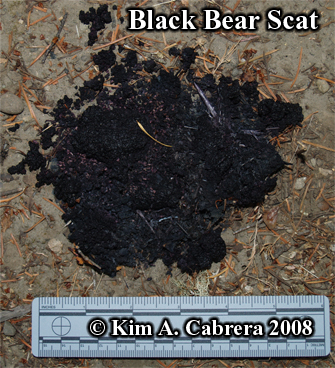
| For more about bear scats, visit the Black Bear Scat Page | |

Click on the
photo above to take a Journey to Bear Orchard.
|
|
|
|
|
I never lived in bear country until
about 27 years ago, when I moved to northern
California. Black bears are abundant I have seen several black bears close up. One was raiding my garbage cans one night. I heard noise outside and opened the door to see what it was. I startled the bear, who ran about 50 feet, then climbed up a tree and clung there, looking at me and grunting. I went back inside to watch what it would do. It climbed down from the tree and cautiously approached the garbage again. I flung open the door and the bear took off running. (Don’t try this at home.)
The next bear I saw was a young one that had developed a taste for food from campsites that were unoccupied. (This happened in the park where I worked summers.) I was working in the campground entrance one day when two guys came up and told me they’d seen a bear about 50 feet down the road. I went to look and, sure enough, there was the little bear. He stood still, thinking I hadn’t seen him. When I began to move down the road, he took off running for the brush. He stopped after a short distance and put his paws up on a tree as if to climb. When he realized I wasn’t following him, he sauntered off into the brush. This same bear gave me an entertaining summer following his trails around the campground. Bears are fairly habitual and will stick around an area where there is easy food. This one decided that he liked the sort of foods people bring camping. He established a network of trails all the way around the campground perimeter, just out of sight. He’d keep himself hidden in the thick brush or up on an abandoned road that ran up a hill behind the camp. When someone left food out in a campsite, he would scurry down and grab it and cart it back up the hill, where he ate the prize. His trail system provided him a
highway between two campgrounds and some of his
favorite resting areas. The best bear day bed that
I’ve ever found was one this bear used. It was an
old apple tree, overgrown with blackberry vines,
and surrounded by brush and grass. The tree had a
large, horizontal limb that provided the bear with
a hammock in which to lounge away the warm summer
days while he nibbled apples from the tree, or
berries from the vines. The creek ran not 20 yards
from the bear’s hangout, providing fresh water
anytime. It was the perfect bear hangout. It has
been used several years in a row now. (Note: This
was written in 1997. That old tree is still there,
but completely overgrown with berry vines now! As
of 2018.) |
|
I find bears challenging to track because their feet are relatively flat. They walk plantigrade, or flat-footed. You would think that such a large animal would leave huge imprints. Actually, they don’t. Most of the time, the tracks I find are indistinct flattenings of the soil. It's like tracking someone walking around in their socks. Every once in a while, I find a nice clear print showing all five toes and maybe the claws. Usually the claw marks are not visible. And, sometimes, the fifth toe doesn’t make an imprint. Tracking bears is like tracking barefoot humans. There are no sharp edges on the feet to leave distinct impressions on the ground. I’ve made plaster casts from numerous bear tracks. Recently, I made a cast of a print in fine river silt. The cast shows the hair on the foot! Bears are intelligent animals and their trails will yield endless hours of entertainment, if you are willing to spend the time. You’ll learn a lot about bears just by following their tracks. It’s time well spent. |
|
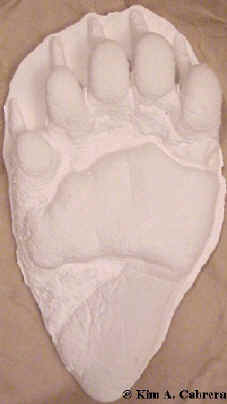
| Plaster cast of the hind track of a young black bear. This is from a mold. Note the short claws and the shape of the heel pad. Claws do not always show in tracks. | |
| The garbage in this photo was left behind by a black bear who raided my dumpster one night. I was outside and heard a crunching sound coming from the brush. I had found bear tracks earlier, so I knew who was probably out there in the brush. I got my air horn and flashlight and quietly made my way closer to the sound. The bear stepped out of the brush and I hit the air horn. That bear jumped and took off running! The way to keep bears out of your garbage it to re-educate them by making them think the garbage is an "unfriendly" place. Noise is a good way to do this. You have to start the bear re-education program before the bears have become used to getting into your garbage, otherwise, it's probably too late to re-train them. |
|
|
|
These five claw marks were left by a black bear that tried to get into a dumpster full of smelly garbage. Bears love to get into garbage and are able to open the plastic lids on dumpsters easily. |
|
|
|
|
These log stumps were torn into by a black bear. |
|
|
|
|
|
A beautiful right front track from a black bear in fine dust. The fur even left some imprints here. |
|
 |
|
| A clear left hind track left in dust. | |
 |
|
|
This tree was climbed repeatedly by a black bear cub. The claw marks are two years old in this photo, which was taken in 1997. This tree is located next to a trail leading to a small (3 campsites) primitive campground in northern California's redwood country. The bears were seen frequently that summer and one tent was ripped open by a bear trying to get food while the people were away from the campsite. The bears were not being aggressive. They simply are after food and there was food in the tent. Proper food storage would have prevented the damage done by the bear. They are curious and strong, but not confrontational. |
|
|
The Bear in the Yard - A True Tale |
||
| A friend of mine is a park ranger at one of the California redwood state parks. He lives right in the park and has many species of wildlife that visit. One day, I went to visit and, as I drove up to their gate, I saw a covey of quail on the grass. I got out the camera and took a couple pictures of the quail. I had not looked up toward the gate because I was distracted by the quail. As the quail flew off, I turned my attention to the gate. Looking through it, I saw a big dark shadow under a tree moving. Sure enough, it was a bear! I got out of the car, walked up to the gate, and started taking photos of the bear. This was a black bear, the only species of bear found in the wild in California. | 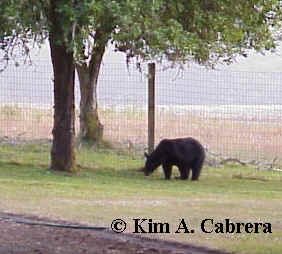 |
|
|
|
|
The bear was happily feeding on pears that had fallen off a tree in the yard. These trees are part of an orchard left over from the builders of the house, who lived here before the land belonged to the park. |
| The park's campground is just across the road that is visible behind the bear in the photo below. Occasionally, bears visit the campground in search of scraps of food. The park has a bear management program which includes requiring campers to properly store their food in bear-proof lockers, disposing of waste in bear-proof garbage cans, and not feeding wildlife. The rules are strictly enforced because bears are intelligent animals. Once a bear learns it can get food from people, it will keep coming back for more. By educating the campers about how to camp in bear country, bear problems can be avoided. | ||
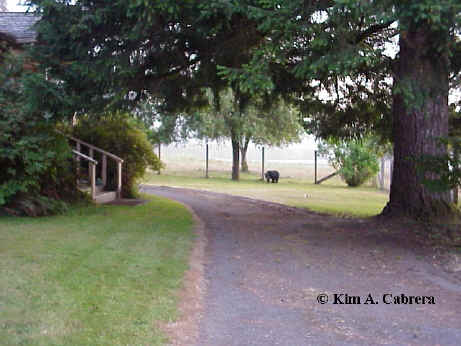 |
The fence that completely encloses the yard is meant to keep out the elk, who live on the prairie here. This is the first view I had of the bear. It didn't seem bothered by my presence at first. I stayed on my side of the fence and took a few photos. The bear must have decided it didn't like being watched because it decided to leave. It climbed up on the fencepost behind it in one big leap. (Black bears climb very quickly.) It then dropped down on the other side and bounded away. Take a look at the two videos below to watch the bear feeding and jumping the fence. | |
|
VIDEO: Black bear feeding under a pear tree. (632K) |
VIDEO: Black bear jumping over the fence and bounding away. (539K) | |
|
|
|
 |
|
Got a bear story? E-mail me and tell me about it. |
||
|
You are visitor number: |
||
|
Copyright © 1997, 2010, 2011,
2018. Text, photos*, and drawings by |
||
|
*Except otherwise noted:
Bear pictures from The Bear Den. |
||
|
||
|
Page updated: June 11, 2018 |
||
|
|
Find bears and bear tracks items in my
new store.
Greeting cards, hats, calendars, posters, t-shirts,
stickers,
clocks, and much more. Custom bear products are available.
Just send me an
email with your request.
| Check out Beartracker's online
store at: www.dirt-time.com
Happy tracking!!
What else can you find in the nature store? Beartracker's T-shirts, sweatshirts, journals, book bags, toddler and infant apparel, mouse pads, posters, postcards, coffee mugs, travel mugs, clocks, Frisbees, bumper stickers, hats, stickers, and many more items. All with tracks or paw prints, or nature scenes. Custom products are available. If you don't see the track you want on the product you want, email me and I can probably create it. Proceeds from all sales go to pay the monthly fees for this web site. You can help support this site as well as get great tracking products! Thank you! |
| Find other tracking products: www.zazzle.com/tracker8459* |
| Also
visit these fine stores for more products of
interest:
NDN Pride shop - For Indian Pride items for all tribes. Custom items available on request. ASL Signs of Love - For anyone who uses or is learning ASL, American Sign Language. Custom name items and more are available here. Get Every Child Outdoors (Get E.C.O.) - My shop dedicated to nature and getting kids interested in nature and the outdoors. Sales from all stores give commissions to Beartracker's Animal Tracks Den, which helps keep this site online as a free service. We are celebrating ten years online this year! |
|
If you wish to help keep this
site online, donations are accepted through
PayPal. |







 here. No grizzlies live in
California (except in zoos). The last California
grizzly was shot in 1922 in Tulare County. In
Humboldt County, where I live, the first explorers
through the area encountered numerous grizzlies as
they made their way south. This was in late 1849
and early 1850. In fact, one of the explorers was
attacked by a grizzly near the present-day town of
Miranda.
here. No grizzlies live in
California (except in zoos). The last California
grizzly was shot in 1922 in Tulare County. In
Humboldt County, where I live, the first explorers
through the area encountered numerous grizzlies as
they made their way south. This was in late 1849
and early 1850. In fact, one of the explorers was
attacked by a grizzly near the present-day town of
Miranda.