|
|
|
Lepus californicus |
 |
|
Black-tailed Jackrabbit Tracks |
| Front feet: 1 7/8 - 2.5 in L x 1.25 - 1.75 in. W |
| Hind feet: 2.5 - 5.5 in. L x 1 3/8 - 2.5 in W |
|
|
|
Lepus californicus |
|
|
Black-tailed Jackrabbit Tracks |
| Front feet: 1 7/8 - 2.5 in L x 1.25 - 1.75 in. W |
| Hind feet: 2.5 - 5.5 in. L x 1 3/8 - 2.5 in W |

|
|
|
 |
The black-tailed jackrabbit is the most
widespread jackrabbit. It lives on river bars, in
meadows, barren areas, and sand dunes. The jackrabbit
is a hare, which means its young are born with fur and
with their eyes open. They are most active in the late
afternoon, preferring to spend the day resting in a
form, a shallow depression the size of its body that
the animal scoops out of the dirt.
Jackrabbits eat grasses and leafy vegetation in the summer. In winter, they feed on woody or dried vegetation. Sometimes these social animals will feed in groups. Jackrabbits have excellent hearing. Their ears can be 5 inches long. In addition to collecting sound, the large ears serve to disperse some of the animal's body heat on hot days. |
| Jackrabbits can weigh three to six pounds.
Although they are larger than cottontails, the hind
tracks may appear smaller because jackrabbits tend to
run on the toes of the hind feet. The long heels do
not leave marks when the animal is running like this,
but they do when the animal is sitting. The hind feet
can be 5¾ inches long. Jackrabbits rarely walk. They
can leap five to ten feet at a time. At top speed, the
animal can leap 20 feet or more. They can run 30 to 35
miles per hour over a short distance. When running,
the animal sometimes jumps exceptionally high every
few leaps to get a look around.This is called a spy
jump. |
|
|
The white underside of the tail is flashed when escaping from a predator. This may confuse the predator or warn other jackrabbits of danger. Jackrabbits will also thump the ground with their big hind feet to signal danger. The home range of a jackrabbit is about ten acres. Altricial jackrabbit young are born in a deep form lined with soft materials, including fur from the mother's chest. These animals are prolific, with one to four litters of up to eight young born each year. Sometimes the mother will place the young in separate forms to decrease the chances that a predator will find them all. She stays away from them during the daytime and returns several times a night to nurse the young. This is a way of avoiding attracting the attention of a predator. The young can take care of themselves in one month. Common predators include foxes, owls, hawks, snakes, and coyotes. Tracks in mud sometimes show the hair on the bottom of the feet. In sand, the trail pattern, stride length, and the size of the imprints are the best indicators of jackrabbit tracks.
|
|
|
|
|
|
Left front track. The amount of fur on the feet obscures the details of the toes. |
Right front
track. Although the fur blurs the details, you can
make out imprints of the toes. There are three outer
toes (to the right) and one inner toe (to the left.)
The fifth toe is not seen. Sometimes, it shows up as a
claw imprint. |
|
|
|
|
The toes left good imprints in this left hind footprint |
The right hind track shows nice details of the toes and fur. |
|
Scat is a spherical pellet about ½ inch in diameter. |
|
|
|
|
| More black-tailed jackrabbit scats. Their scats can look like squished spheres, or they can be more round in appearance. Jackrabbits produce two kinds of scats. The cecal scats are first. These are eaten (called autocoprophagy) to take advantage of a second run through the digestive tract. This helps the animal gain as many nutrients as possible from the foods they eat. | |
 |
|
| Dried
jackrabbit scats found in a field where the animal had
been feeding. Jackrabbits produce one pellet at a
time, unlike deer, which expel many pellets in a large
clump. Because of this, you can
tell that, if you find many jackrabbit scats in one
place, that means the animal was in that spot for a
while, or that it repeatedly returned there to feed.
One study states that a single jackrabbit produces about
545 pellets per day! |
|
 |
|
| Jackrabbit sitting up alertly, wary of predators. | |
 |
|
| Jackrabbit alert and poised, ready to run away. | |
 |
|
| Jackrabbits use their large ears to listen
for danger. The ears also help them disperse heat. |
|
 |
|
|
When they gallop, jackrabbits can make very long leaps. This position is called extended suspension and is one of the airborne phases of the rabbit's gait, normally a bound.When covering large open areas, they move fast! |
|
 |
The front foot of a jackrabbit, cast in plaster of Paris. This cast shows details not usually seen in the tracks. The bottom of the foot is covered with hair and the toes are indistinct. |
| The hind foot of the jackrabbit is much longer than the front foot. When the animal moves, the entire foot surface is not usually in contact with the ground, so the tracks do not appear this large. |
|
 |
|
|
A perfect jackrabbit track in mud. Very good detail of the furry sole can be seen here. You can also see the holes left by the claws at the tip of the track. I made a cast of this track, which is below. The cast shows some good detail. One thing you can see here is the small inner toe, toe number one. (It's that tiny imprint with a claw next to the LF in the photo.) This is difficult to see in jackrabbit tracks because it is small and usually obscured by fur. |
|
 |
|
|
A cast made of the jackrabbit track above. Notice that the detail of the fur shows up well in this cast. You can also more clearly see the alignment of the toes here. Claw marks are visible. The red arrow indicates the direction of travel. Notice that toe number one only shows up here as a claw mark. |
|
 |
|
|
The left front track of a black-tailed jackrabbit. Notice the lack of clear detail on the toes, due to the furry feet. Also, the toes are not aligned perfectly, which is characteristic of the tracks of lagomorphs (rabbits, and jackrabbits or hares) |
|
 |
|
|
The right front track of a black-tailed jackrabbit. Notice that the toes are offset, making a sort of J shape. Their alignment is not perfect, as it is in canines. |
|
 |
|
| A beautiful pair of paw prints in sand on a recently graded dirt road. Jackrabbits have very furry feet and the toes do not usually leave clear imprints. The fur is thick and protective. | |
|
|
|
|
|
Jackrabbits are prey for many larger mammals and must be very wary when out and about. They frequently stop to just sit and listen for danger. One common technique when startled is to run quickly into the brush and then stop and freeze and listen. This allows the animal to determine whether or not a predator is pursuing it. |
| This jackrabbit flushed from the brush ahead of me on a dirt road. I happened to have the camera in hand and snapped this shot as it ran away. You can clearly see that the bottoms of the feet are covered with fur, which makes for unclear tracks. Also, you can see why the toe-pads are not very clear in jackrabbit tracks. |
|
|
|
This is a perfect set of jackrabbit tracks on a beach at the Manila Dunes, near Eureka, CA. The direction of travel is indicated by the arrow. The smaller tracks on the upper left are the front feet. The larger and deeper tracks at lower right are the hind tracks. This gait is called a gallop. |
|
|
Blacktailed jackrabbit tracks found on a dusty dirt road. These are almost ideal conditions for finding tracks. Lighter weight animals, such as rabbits and lizards, leave nice footprints on this kind of soil. These jackrabbit paw prints are moving from right to left in the photo. This gait pattern is typical of rabbits and hares. A jackrabbit is a hare, which is an animal whose young are born with their eyes open, having fur, and able to move about on their own.This gait is called a bound. |
| Black-tailed jackrabbit scats in gravel. Scats are composed of well-packed vegetation that the rabbits feed on. Jackrabbits, as well as other species, practice autocoprophagy. This means that some of their scats are passed through their digestive system twice. The first time, some nutrients are removed and used by the animal's body. Those pellets are then excreted. They are darker than other pellets. These pellets are then eaten by the animal and the nutrients are used by its body. This is a good way for animals, particularly in areas with a scarcity of food, to completely utilize the nutrients in their food. |
|
|
|
|
|
These scats show the spherical form of typical jackrabbit scats. |
|
|
|
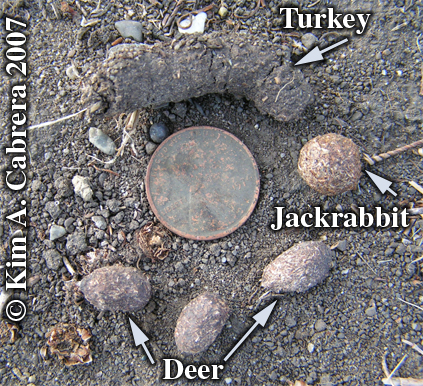
The three different scats on the left are provided to compare between different herbivore species. Deer scats are more oblong than those of rabbits. Turkeys are more tubular and larger than the others. All are composed of similar material. |
|
|
 |
|
Close-ups of jackrabbit scats. These scats look like highly compressed balls of hay. This is, in effect, what they are. Compressed vegetation. |
|
 |
|
| View of blacktailed jackrabbit feeding sign on a wild clover related plant. | |
 |
|
| Close up showing the clean cuts that are characteristic of jackrabbit feeding sign. | |
 |
|
| The nice clean 45 degree cut is typical of rabbits, including the jackrabbit. | |
 |
|
| This plant was about as wide as a pencil. The clean cuts and size of vegetation indicate jackrabbit feeding. | |
 |
|
| A beautiful example of jackrabbit feeding sign. | |
 |
|
| In the absence of other plants, the jackrabbit will continue to clip this plant down to the ground. | |
 |
|
| Nice illustration of the 45-degree cut made by a jackrabbit. | |
 |
|
| Often, all you will find to indicate jackrabbit tracks is the prints from the nails. | |
 |
|
| This perfect jackrabbit print shows the offset of the toes and the overall shape of the print. | |
 |
|
|
A nice example of a jackrabbit trail pattern in the sand of a coastal sand dune. This jackrabbit was leaping up the dune and the feet fell closer together in each group.This gait is a bound since both hind feet landed together. |
|
| A nice set of jackrabbit tracks in silty soil. The rabbit was hopping slowly from left to right. The front feet are paired in this photo. Normally, they are staggered. The larger hind feet are on the right. |
|
|
|
Young jackrabbit out feeding in early evening. This animal was about half the size of an adult. |
 |
|
| Blacktailed jackrabbit ready to run. | |
 |
|
|
Blacktailed jackrabbit grooming its fur. |
|
|
|
|
| Blacktailed jackrabbit scats. | |
 |
|
| Jackrabbit resting at the side of a road. | |
 |
|
| Blacktailed jackrabbit running. | |
 |
|
| Blacktailed jackrabbit track in dust. | |
|
A set of all four jackrabbit tracks. The two on the right are the front tracks and the paired ones on the left are the hind tracks. This bound is the typical jackrabbit gait pattern. The direction of travel is from right to left.When they speed up, they often us a gallop pattern. |
 |
 |
|
|
Reading the tracks. A blacktailed jackrabbit sat here and then made a change of direction. It was heading directly to the left, but paused here, then hopped off to the upper left. Notice the long hind tracks where it sat down and then the smaller front feet leading off in the new direction. |
|
 |
|
|
A blacktailed jackrabbit was heading to the upper left in this photo. It paused and sat here briefly. Rabbits will often sit still and listen for danger. The bobcat's track crosses the rabbit's, heading toward the lower right in the photo. |
|
 |
|
| The toe prints of a jackrabbit in dust. This
is the left foot. The toes were the only part that
left an imprint here. Notice how the toes are asymmetrically aligned. |
|
 |
|
| Jackrabbit scat in a dry grassy field. | |
|
|
|
| The front and hind tracks of a blacktailed jackrabbit. These tracks were made in deep dust. They demonstrate that the heavily furred feet or rabbits and hares leave very little pattern in the tracks. The extra fur probably keeps their feet warm in winter as well as cushioning their steps. This possibly helps them to stay quiet as they move about, something that is important for a prey species. | |
|
|
|
I have seen many of these animals around at dusk. Their populations seem to fluctuate a lot. One year, there will be jackrabbits everywhere. Next year, there may be very few. They have startled me several times when I've been out walking in creekbeds. They freeze and stay very still until danger passes. However, when I inadvertently get too close, the animal will spring away and take off running. I was stepping over a log once when a jackrabbit sprung from underneath it, almost making me lose my balance.
The jackrabbit I mentioned above, the one I called Notch due to the scar in his ear, stuck around all summer. This hare had regular routes used. There were regular feeding spots, and a nice resting "bed" out in the open where he could watch for predators. It was near the tall grass, where he could easily hide. This very open spot provided a 360-degree view all around and was ideal for resting during the day. I'd see him there often. Sometimes, I'd surprise him as I drove out the dirt road. Then, he'd run up the road and take off on one of his well-used trails into the grass.
|
|
|
||
 |
Got a jackrabbit story? E-mail me and tell me about it. You
are visitor number: Copyright © 1997, 2009, 2018. Text and photos by Kim A. Cabrera |
|
|
|
||
Copyright © 1999, 2009, 2018. Kim A. Cabrera - Desert Moon Design
Page updated: June 13, 2018
Find jackrabbit and other animals on various
products at: www.dirt-time.com
All sales go to help support the Beartracker's Animal Tracks Den
web site. Thank you for stopping by! Happy tracking!
|
Visit Beartracker's Nature Store
online store at: www.dirt-time.com
Happy tracking!!
What else can you find in the nature store? Beartracker's T-shirts, sweatshirts, journals, book bags, toddler and infant apparel, mouse pads, posters, postcards, coffee mugs, travel mugs, clocks, Frisbees, bumper stickers, hats, stickers, and many more items. All with tracks or paw prints, or nature scenes. Custom products are available. If you don't see the track you want on the product you want, email me and I can probably create it. Proceeds from all sales go to pay the monthly fees for this web site. You can help support this site as well as get great tracking products! Thank you! |
| Find other tracking products: www.zazzle.com/tracker8459* |
| Also
visit these fine stores for more products of
interest:
NDN Pride shop - For Indian Pride items for all tribes. Custom items available on request. ASL Signs of Love - For anyone who uses or is learning ASL, American Sign Language. Custom name items and more are available here. Get Every Child Outdoors (Get E.C.O.) - My shop dedicated to nature and getting kids interested in nature and the outdoors. Sales from all stores give commissions to Beartracker's Animal Tracks Den, which helps keep this site online as a free service. We are celebrating ten years online this year! |
|
If you wish to help keep this site
online, donations are accepted through PayPal. |
 Black-tailed Jackrabbit