|
|
|||
|
Sylvilagus bachmani |
|||
 |
|||
| Front Tracks: 11/16 in.- 1 in. L x .5 - .75 in. W | Hind Tracks: 1 1/16 - 2 in. L x 9/16 in. W | ||
|
Brush Rabbit Tracks |
|||
|
|
|||
|
Sylvilagus bachmani |
|||
|
|||
| Front Tracks: 11/16 in.- 1 in. L x .5 - .75 in. W | Hind Tracks: 1 1/16 - 2 in. L x 9/16 in. W | ||
|
Brush Rabbit Tracks |
|||
|
|
|||
|
|
|||
|
|
|||
|
Brush rabbits don't venture too far from cover. |
Brush
rabbits are cottontails, rabbits with white cottony
tails. They are found in brushy areas. They are active
dusk and dawn, but are primarily nocturnal. Sometimes,
the young are active in the daytime.
Brush rabbits do not dig burrows like European rabbits do. When escaping from predators, they will retreat into dense brush. They hide by day in brush piles and grassy depressions, resting in forms of their own construction. Brush rabbits are small, weighing only two to four pounds. Like all rabbits, they are prolific. They can have five litters of up to seven young per year. The young are born with their eyes closed and lack fur. The mother hides them in a nest, which she covers with a blanket of grass before she leaves to feed. The babies are mature in four or five months. They eat woody vegetation in the winter, including bark, twigs, buds, Douglas fir, and salal. During the summer, the diet is more varied. They eat grasses, berries, plantain, clover, and other plants. Scat is a round pellet, ¼ to 1/3 inch in diameter. Common predators include foxes, coyotes, gopher snakes, and bobcats. Tracks are often indistinct due to the hair on the bottom of the feet. Tracks are in groups of four prints, with the cluster usually measuring six to nine inches long. |
||
|
This brush rabbit froze at my
approach, another |
|||
|
|
|||
|
A brush rabbit with a piece of vegetation in its mouth. |
|||
|
|
|||
|
A brush rabbit pauses to sniff the air for danger, a frequent occurrence in the life of a prey animal. |
|||
|
|
|||
| This nice set of tracks was left in a dusty dirt road. The rabbit was seen not too far ahead. It was partially concealed by plants. However, when I approached, it immediately jumped into the brush to hide. This is where they got their name. Because they are so small, they are prey for just about all the predators in their habitat. Thus, they rarely venture far from cover and concealment. This gait is a bound. | |||
|
|
|||
|
A full set of brush rabbit tracks in mud. Direction of travel is indicated by the red arrow. The bottoms of the feet are covered with fur, which makes tracks indistinct. The two hind tracks, at the top of the photo, land ahead of the front tracks. The two front tracks are side-by-side at the bottom of the photo. |
|||
|
|
|||
|
A very nice brush rabbit track in mud. The toes splayed here and left clear imprints. The fur on the bottom of the foot also left an imprint. This is about as good as it gets with brush rabbit tracks. |
|||
|
|
|||
|
Another track from the same brush rabbit that left the above track. This one is more obscure and the details are lacking. |
|||
|
|
|||
|
A brush rabbit that was feeding by the side of a dirt road. They are normally quite skittish and dive for cover when approached. |
|||
|
|||
|
|
|||
|
|
|||
|
Brush rabbit and a pair of California quail. |
|||
|
|
|||
|
Brush rabbit in the early morning. |
|||
|
|
|||
|
Another fine set of brush rabbit tracks. This was from a full-grown animal. These are very small rabbits. |
|||
|
|
|||
|
Another good set of tracks found in dust. Paw prints can be indistinct for most rabbit species. They have a lot of fur on the bottoms of their feet, which obscures the details of their tracks. |
|||
 |
|||
|
This is the right front track of a brush rabbit. Notice that the toe pads are asymmetrical. There are four toe pads on the front feet. Paws are covered with fur and don't often leave clear toe imprints. |
|||
 |
|||
|
This right hind footprint shows even more clearly the indistinct outlines caused by the furry feet of the brush rabbit. |
|||
 |
|||
|
This is excellent brush rabbit habitat. Many of them are seen along this stretch of dirt road. They have plenty of food sources and easily accessible hiding places nearby in the brush. The rabbits will come out at dusk and dawn to feed along the roadside. They rest during the day. |
|||
 |
|||
|
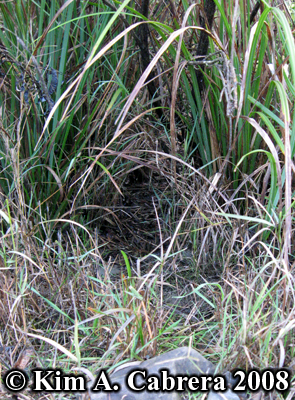
This tunnel through the grass was created by brush rabbits, who use it as a run between feeding and sheltering areas. Many of these runs lead off from the edge of a dirt road where they come to feed. Brush rabbits don't usually venture too far from shelter. They are small and are prey for many animals, so they need a nearby retreat for safety. |
|||
 |
|||
|
Another brush rabbit run. When you find these, you can look closely inside and find clipped off grasses and scats from the animals that use them. |
|||
 |
|||
|
Another tunnel made by brush rabbits. The grass and brush is thick and dense here, making it perfect shelter for rabbits. |
|||
 |
|||
|
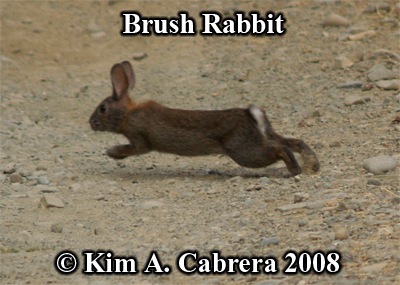
A brush rabbit running for cover. This position in the gait of the rabbit is called extended suspension. The animal's body is extended fully, but it is off the ground. As you can see in this photo, the hind feet are just about to leave the ground, making it almost a true suspension. |
|||
 |
|||
| Brush rabbit feeding on short grasses. | |||
 |
|||
| A brush rabbit startles a California quail as it runs for cover. | |||
 |
|||
| Feeding signs left by a brush rabbit at the site of a drying-up pond. These are sedge plants. | |||
 |
|||
| More brush rabbit feeding signs on pond-side rushes. | |||
 |
|||
| Brush rabbits fed on these cattail plant shoots. | |||
 |
|||
| Brush rabbit feeding on sedges. | |||
 |
|||
| A brush rabbit feeding amidst a covey of California quail. These small rabbits aren't much bigger than a quail. | |||
 |
|||
| A brush rabbit resting in the sun. | |||
 |
|||
| Brush rabbit running for cover after being startled. Notice the white tail that gives them their other name of "cottontail." | |||
 |
|||
| A pair of brush rabbits amongst a group of quail. | |||
 |
|||
| Two brush rabbits feed peacefully alongside a covey of quail. | |||
 |
|||
| Brush rabbits and quail feeding. | |||
 |
|||
| Brush rabbit scats. | |||
 |
|||
| Tiny brush rabbit tracks crossing a dirt road. These rabbits are small and rarely venture far from cover. | |||
 |
|||
| A brush rabbit left these tracks in dust at the road's edge. A deer track is visible in the upper left. | |||
 |
|||
| Brush rabbit pausing to sniff the air. When you are prey for everyone out there, you are very cautious! | |||
 |
|||
| Brush rabbit feeding on vegetation. | |||
 |
|||
| Brush rabbit hopping. | |||
|
|
|||
|
Brush rabbit near cover. |
|||
|
|
|||
| Brush rabbit tracks in sand, Humboldt Redwoods State Park, California. The tracks are indistinct due to the dry sand and the hair on the bottom of the feet. Trail pattern and size of tracks were clues used to identify these prints. | |||
|
|
|||
| The brush rabbit tracks in the photo above show only the tips of the claws. This is often all you will find to indicate a rabbit has been there. Their feet are covered with fur and sometimes won't leave a good impression on some surfaces. | |||
|
|
|||
|
A brush rabbit run leading from a dirt road into dense brush. |
|||
|
|
|||
| These beautiful rabbit tracks in snow are likely from a cottontail (although not the brush rabbit species). The photo was taken in PA and donated. (Thank you!) The arrow indicates the direction of travel. There are several rabbit trails here. In the upper left, you can see how the rabbit took a short hop, then stopped and looked around. See how the larger hind feet have the two smaller imprints left by the front feet inside? This is where the animal sat for a moment. When it moved on, it left the two front tracks just above the stopped ones. | |||
|
|
|
|
| Front foot of a brush rabbit. Hair cover makes tracks indistinct. |
Hind foot of a brush rabbit. There are four toes on each foot, but they are hard to distinguish. |
|
| Photos
taken of feet of a road-killed animal. No animals
are ever harmed so that their feet can be featured on this site! |
||
|
|
|
|
|
One of the areas where I frequently visit and track has brush rabbits. I've noticed that their populations fluctuate. One year there will be many brush rabbit tracks, and the next year or two there may be few or none. The tracks never seem to be far from the underbrush and easy cover. They will venture no farther than that because they need to be able to quickly run back into the protective brush if a fox happens by. Perhaps the high numbers of foxes at this location can be attributed to the numbers of rabbits. |
|
|
||
 |
Got a rabbit story? E-mail me and tell me about it. You
are visitor number: Copyright © 1997, 2009, 2018. Text, drawings, and photos by Kim A. Cabrera |
|
|
|
||
Find brush rabbit posters, greeting cards, postage stamps and more in my new store.
|
Visit Beartracker's Nature Store
online store at: www.dirt-time.com
Happy tracking!!
What else can you find in the nature store? Beartracker's T-shirts, sweatshirts, journals, book bags, toddler and infant apparel, mouse pads, posters, postcards, coffee mugs, travel mugs, clocks, Frisbees, bumper stickers, hats, stickers, and many more items. All with tracks or paw prints, or nature scenes. Custom products are available. If you don't see the track you want on the product you want, email me and I can probably create it. Proceeds from all sales go to pay the monthly fees for this web site. You can help support this site as well as get great tracking products! Thank you! |
| Find other tracking products: www.zazzle.com/tracker8459* |
| Also
visit these fine stores for more products of
interest:
NDN Pride shop - For Indian Pride items for all tribes. Custom items available on request. ASL Signs of Love - For anyone who uses or is learning ASL, American Sign Language. Custom name items and more are available here. Sales from all stores give commissions to Beartracker's Animal Tracks Den, which helps keep this site online as a free service. We are celebrating ten years online this year! |
Copyright © 1997, 2009, 2018. Kim A. Cabrera - Desert Moon Design
Page updated: June 13, 2018
 Brush
Rabbit
Brush
Rabbit 


