|
|
|
|
Mephitis mephitis
|
|
|
|
|
|
Front Track |
Hind Track |
|
7/8 - 1 1/2 in. L x 3/4 - 1 3/16
in. W |
15/16 - 1 13/16 in. L x 13/16 - 1
1/4 in. W |
|
Striped Skunk
Tracks |
|
|
Long front claws for digging.
|
|
|
|
|
|
|
|
|
Skunk
tracks show five toes on the front foot and five on the hind foot. The front tracks
usually show claw marks farther ahead of the toe marks than the rear prints
do. This is because the skunk has longer claws on the front feet to use in
digging up roots and insects. |
|
|
|
|
|
|
|
|
This is a perfect left front striped skunk
track. In fact, you can see features in this track that do not often show up
in the front tracks of skunks! As you will see in the photos below, the front
track often only shows the metacarpal (heel) pad. In this beautiful perfect
print, you see the metacarpal pad, but also the carpal pad. See the two
paired pads that are at the bottom of the photo? The one on the left is the
carpal pad. The one on the right is another metacarpal pad. In striped skunk
tracks, these pads rarely make an imprint. It may be due to the way skunks
walk or to the substrate, but it is not common to find such a perfect and
complete front footprint! |
|
|
|
|
|
|
|
|
Perfect
left front striped skunk track, showing long claws for digging |
|
|
|
|
|
|
|
|
Left front striped skunk track in mud. You can clearly see the front claw marks way ahead of the toes in this track. This characteristic allows you to identify the front track. Longer front claws are used by the skunk for digging. Hind tracks have shorter claws. |
|
|
|
|
|
|
|
|
Right hind
striped skunk track. Only one claw left an imprint here. |
|
|
|
|
|
|
|
|
Left front
striped skunk track in dust. Front tracks have longer claws. |
|
|
|
|
|
|
|
|
Striped
skunk trail across mud that has been rained on |
|
|
|
|
|
|
|
|
Right hind striped skunk track in dust. The shorter claw marks identify this as the hind print. |
|
|
|
|
|
|
|
|
Striped skunk tracks showing only the claw marks. This
happens in firm soils. you can tell these are skunk tracks because they have
five long claws. Rabbits often leave only claw marks as well, but their feet
are asymmetrical. |
|
|
|
|
|
|
|
|
A nice left front striped skunk track in firm sand. This one barely shows an imprint from the foot. It is mostly claw marks. |
|
|
|
|
|
|
|
|
Striped
skunk tracks in firm sand |
|
|
|
|
|
|
|
|
A pair of striped skunk tracks in dust. The top one shows the long claws that are found on the front foot. The bottom track is the hind track. The hind track usually shows the longer metatarsal pad, but sometimes it is not visible. Hind feet have shorter claws than front feet. |
|
|
|
|
|
|
|
|
A striped skunk ignores a bobcat walking past it with prey in its mouth. Either the skunk doesn't fear the bobcat because he has spray to defend himself with, or he's not worried because the bobcat already has captured some prey. The prey looks like a brush rabbit. This image was captured on my trail camera and is one of the best images I have ever gotten with it. |
|
|
|
|
|
|
|
|
In this photo, a striped skunk goes about
its business searching for food in short grass. I was standing 10 feet away,
filming it. It went on about its business for a few minutes, then it looked
up and saw me. |
|
|
|
|
|
|
|
|
In this photo, the skunk has seen me and is
trying to decide what to do. I was not moving at all. I made no noise either.
I just watched. The skunk thought for a minute, then decided to see if it
could scare me off. |
|
|
|
|
|
|
|
|
The skunk charged right at me, stomping its front feet in a stiff-legged stance. It raised its tail and ran straight toward me. I didn't move. The skunk couldn't quite figure out what this large animal was doing so close to it. (See next photo) |
|
|
|
|
|
|
|
|
Finally, the skunk must have decided retreat was the best option. It turned tail and ran away. It was an interesting encounter and I'm lucky I didn't get sprayed. But I did learn a little bit about skunk behavior. I think it decided that an animal that does not run when charged by a skunk could be dangerous. At least that's what I hope it thought. :) |
|
|
|
|
|
|
|
|
|
|
|
|
|
|
A very young striped skunk. This one was with another young animal outside my door one night. I heard rustling in the grass and opened the door to find these youngsters out there. |
|
|
|
|
|
|
|
|
Digging by
a striped skunk in a coastal sand dune habitat. |
|
|
|
|
|
|
|
|
A skunk
whose photo was taken with a trail camera |
|
|
|
|
|
|
|
|
Striped
skunk showing his tail to the camera |
|
|
|
|
|
|
|
|
Young
striped skunk |
|
|
|
|
|
|
|
|
They forage by digging. Sometimes,
you will find these small holes dug out by skunks. They will also get into
garbage cans. |
|
|
|
|
|
It
has been said that skunks can be discouraged from visiting by scattering a
few mothballs around on the ground. They are supposed to be repelled by the
smell of camphor. Three
to eight young are born blind and are weaned at six to seven weeks. Skunks
are omnivorous, eating mice, eggs, insects, grubs, fruit, carrion, and
shrews. Great
horned owls are predators that commonly eat skunks. Skunks
find shelter under buildings or in ground burrows taken over from other
animals. Skunks are active year-round. |
|
|
|
|
|
A striped skunk that I encountered out and about one night. |
|
|
|
|
|
|
|
|
Striped skunk tracks. The hind foot is visible as a
lighter imprint atop the front track. The front track exhibits the long claws
that the skunk uses for digging for food. |
|
|
|
|
|
|
|
|
A nice right front track, showing the longer claws found on the front foot of the skunk. |
|
|
|
|
|
|
|
|
A pair of striped skunk tracks. The hind track left
imprints only from the toes as the rock took most of the animal's weight.
Variations in tracks are the norm, so never expect that the tracks you find
will look exactly like the ones in the field guides! |
|
|
|
|
|
|
|
|
A nice gait sequence from a striped skunk. This pattern is produced by the normal walking gait. |
|
|
|
|
|
|
|
|
A nice right front striped skunk track in mud. The skunk stepped on this fine mud and deposited some sand that had been clinging to its paw. The long claws left small imprints ahead of the toes. This is a right front paw. The particles of sand that are on top of the mud surface had adhered to the skunk's foot and were carried forward. This is called "transfer" by trackers. It is when one material is stuck to the foot and is carried forward and deposited with the next step (or steps, as this can carry forward for many more steps, depending on the material.) |
|
|
|
|
|
|
|
|
A very nice left front pawprint from a striped skunk. The long claws tell you that it is the front paw. The front paws are used for digging and foraging. The inner toe is the smallest toe, just like in bear tracks. |
|
|
|
|
|
|
|
|
A left front paw print from a striped skunk. The quarter gives you an idea of the track size. Always include an item of known size in your track photos to give them scale. Can you see the hind track? It is overlapping the front here. |
|
|
|
|
|
|
|
|
A nice
right front paw print in dried mud. This skunk's claws left nice clear
imprints. |
|
|
|
|
|
|
|
|
Striped skunk track in dusty soil. The shorter claw marks indicate this is the hind track. The front paw has long claws. |
|
|
|
|
|
|
|
|
A nice
skunk right hind track in dust. |
|
|
|
|
|
|
|
|
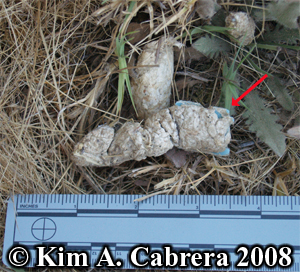
This is why animals should be kept out of garbage. This skunk got into a garbage can and ate the little bread tie thing. It went through his digestive tract and came out in the scat. These plastic items could kill an animal. Always keep garbage cans tightly sealed and keep them locked up where animals can't get into them until collection day. The animals will be safer. |
|
|
|
|
|
|
|
|
|
|
|
If the
skunk raises its tail and twists its body around so the back end is pointing
your way..... watch out! |
|
|
|
|
|
|
|
|
A striped
skunk dug into this underground wasp nest and ate the wasps. |
|
|
|
|
|
|
|
|
|
|
|
Striped
skunk on trail camera |
|
|
|
|
|
|
|
|
Trail
camera view of striped skunk |
|
|
|
|




|
|
|
Striped skunk left hind foot cast from a mold. Note claw length. |
|
|
|
|
|
A
striped skunk that visited me, looking for food. |
|
|
|
|
|
A beautiful striped skunk track in mud. This footprint |


|
|
|
|
|
|
|
I once lived in a house that had a family
of skunks denning underneath. The smell got to be pretty strong after a
while, but it was still tolerable. Eventually, they moved out on their own. I
have had several close encounters with skunks, but have been fortunate enough
to have not been sprayed by one. I came close one night though. I
accidentally startled a skunk that was raiding my cat's food dish. The
skunk's tail went up and I went the opposite direction - fast! |
|
|
|
|
Find
skunk posters, greeting cards, t-shirts, hats, and more in my new store.
|
Visit Beartracker's Nature Store at: www.dirt-time.com Happy tracking!!
What else can you find in the nature store? Beartracker's T-shirts, sweatshirts, journals, book bags, toddler and infant apparel, mouse pads, posters, postcards, coffee mugs, travel mugs, clocks, Frisbees, bumper stickers, hats, stickers, and many more items. All with tracks or paw prints, or nature scenes. Custom products are available. If you don't see the track you want on the product you want, email me and I can probably create it. Proceeds from all sales go to pay the monthly fees for this web site. You can help support this site as well as get great tracking products! Thank you! |

|
Find other tracking products: www.zazzle.com/tracker8459* |
|
Also visit these fine stores for more products of
interest: NDN Pride shop - For Indian Pride items for all tribes. Custom items available on request. ASL Signs of Love - For anyone who uses or is learning ASL, American Sign Language. Custom name items and more are available here. Get Every Child Outdoors (Get E.C.O.) - My shop dedicated to nature and getting kids interested in nature and the outdoors. Sales from all stores give commissions to Beartracker's Animal Tracks Den, which helps keep this site online as a free service. We are celebrating ten years online this year! |

 Got a skunk story? E-mail me and tell me
about it.
Got a skunk story? E-mail me and tell me
about it.


You are visitor number: 
All counters reset in October 2000
Copyright © 1997, 2009, 2010, 2018. Text and drawings by Kim A. Cabrera
Updated: Jan. 27, 2020
Copyright © 1997, 2009, 2010, 2020.
Text, drawings, and photos by Kim A. Cabrera - Desert
Moon Design