|
Turtle Tracks and Signs
(Western Pond Turtle) |
|
|
Western Pond Turtle |
||
 |
||
|
The right front track of a Western Pond Turtle |
||
|
|
Turtle Tracks and Signs
(Western Pond Turtle) |
|
|
Western Pond Turtle |
||
|
|
||
|
The right front track of a Western Pond Turtle |
||
|
|
|
|
|
|
|
|
|
|
Turtles are fascinating animals that carry their homes around on their backs. They have a hard shell, called a carapace, that encloses all their internal organs. Tortoises are turtles that retract their heads into their shells by pulling their neck into an S-shaped curve. Some turtles hide their heads by bending their necks sideways. Turtles vary in size. Small North American box turtles can be six inches long, while the huge leatherback sea turtles can reach eight feet in length. Turtles do not have teeth. While some turtles are vegetarians, most are omnivorous. Turtles lay their eggs in sand or dirt. A few turtles live a long time, some reaching 100 years. The eggs are leathery, rather than hard like bird eggs. Some pond turtles have webbed feet. One of the largest pond turtles in the world is the alligator snapping turtle. It can get up to 200 pounds. Look for turtle tracks near water. The best time to look for them is the summer or fall. Females come out of the water to lay their eggs in late spring or early summer. They did a hole in soft sand to deposit the eggs in. Some land-dwelling turtles will dig burrows. Sometimes the tail or shell will leave drag marks in the trail. The tracks are almost oval in shape with the toes showing on one side of the oval. There are five toes.
|
|
|
|
|
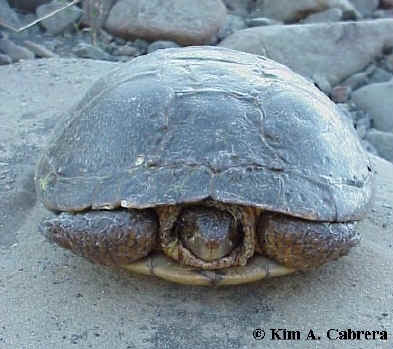
| Notice how this pond turtle has drawn its head into the protective covering of its shell. Turtles have many ways of protecting themselves. They are alert and wary and will dive into the water if they are approached too closely. They can remain underwater until the threat goes away, or simply surface only enough to allow the nose to stick above water, allowing them to breathe. |
|
|
|
The left front foot of a western pond turtle. Notice the webbing between the toes. This helps them swim. If you would like to see a turtle swimming, see the Turtle Underwater Videos. |
| This view shows the toes spread and the webbing is prominent. You can see why turtles are good swimmers. They may move slowly on land, but they are much faster in the water. Their four webbed feet propel them with ease. |
|
|
|
This trail of parallel turtle tracks was found just above the water's edge. Turtles are normally found near water. |
|
A close-up showing several turtle tracks and their size. The claws usually leave good marks, while the feet themselves may or may not make a distinct mark. |
|
|
|
A sandy right front turtle foot. |
| Nice view of the webbed right hind foot of a pond turtle. When swimming, these webs are spread wide and act as large paddles, moving the turtle through the water with ease. |
|
|
|
The left front foot of a pond turtle folded back to protect the animal. This is the retracted position the turtle holds when it retreats into the shell. The front feet have long claws. |
| Some nice turtle tracks with prominent claw marks. There are two trails here, one on top of the other. The direction of travel is from bottom to top in the photo. |
|
|
|
Very nice footprints of a pond turtle in sand. The right front and right hind tracks are clearly visible. Damp sand is a great medium for tracking because it holds the shape of the footprint for a long time. Dry sand is the opposite. |
|
|
|
 |
|
|
Tiny scat of a pond turtle hatchling. |
|
|
|
|
|
Close up of the turtle hatchling scat. Turtles normally deposit their scats in water, so they are hard to find in the wild. |
|
|
|
|
|
|
|
| My Turtle Videos | |
| Filmed along the south fork Eel River in northern California, USA | |
| Pond Turtle Tracks Video | |
| Turtle Basking on Cliff (approach from the water) Video | |
| Turtle Video 1 | |
| Turtle Video 2 | |

Personal Notes on
Turtles
|
|
This turtle had crawled up
onto a very steep rock face at the base of a cliff
above the river. The benefit of this position is that
the turtle merely had to let go and slip back into the
water and there was a shelf under which it could hide
just below the water surface. A perfect place to bask
and avoid predators! Notice how closely the turtle is
keeping an eye on the photographer too. I was not
allowed to get too close.
Being reptiles, turtles have to get their warmth from external sources, such as sitting in the sun. They are called exotherms because of this. |
| Late one afternoon, I came to the river to look for tracks. I found this turtle basking on a rock above water level. It watched my slow approach with caution. When I got too close for comfort, the turtle dove underwater. Small animals have to be wary because predators are always looking for them. |
|
|
More Pond Turtle
Photos (Actinemys marmorata) |
|
|
|
|
| This turtle hatchling was found about 300 feet from the river's edge in early summer. It was about two inches long. |
This adult turtle was basking at the edge of the water. |
|
|
|
| A view of a turtle that had just climbed out of the water. | Closer view of the turtle on the left. |
 |
 |
| Basking turtle. Turtles are not warm blooded, so they have to use the warmth of the sun to warm up their bodies. The will bask in the sunlight to do this. | Turtle on a steep rock face. |
 |
 |
| Turtle walking at the edge of the river. | Pond turtle on a mossy rock. |
 |
 |
| This wary turtle was watching me closely. | A steep rock face provides a nice spot for basking in the sun. |
 |
 |
| Turtles have claws that they use to help them climb out of the water. | This turtle was enjoying a nice summer day. |
 |
 |
| The shell of a turtle offers it protection. | A turtle can completely retreat into the shell for protection from predators. |
 |
 |
| The nostrils are at the very end of the snout, which allows them to float underwater and just stick the snout out to breathe. | Turtle beginning to climb out of the water. |
 |
 |
| Eyes closed, a turtle looks very relaxed in the sunshine. | A pair of turtles on the steep cliff face. |
 |
 |
| Cautious turtle. | Turtle swimming in the river. |
 |
 |
| Turtle enjoying the end of the day. | Ahh, a basking rock! |
 |
 |
| Turtle swimming underwater. The feet alternate when swimming. These photos were taken from a video clip I shot as the turtle swam under me. | The webbing on the hind foot is visible on this swimming turtle. The webs help them move swiftly through the water. They may move slowly on land, but turtles can move better in the water. |
 |
 |
| Another view showing the turtle swimming underwater. | A close-up of the face of a turtle. Their nostrils are at the tip of the snout. This can allow the turtle to rest underwater with just the tip of its nose sticking out. It's probably a good way for them to stay safe from predators. |
 |
 |
| This turtle picked a very steep cliff face on which to bask. | A view of a turtle as it exits the water and climbs out onto a rock face to bask. |
 |
 |
| A happy turtle basking in the summer sun. | This turtle is still wet because it had just climbed out of the water. |
 |
 |
|
Turtles are cautious, not coming completely out of the water until they are sure the surroundings are safe from predators. |
This turtle had caught a bit of algae on its back. |
 |
The river near my home has numerous pond turtles. Unless you spend time really looking at the river, you won't see them. A casual glance often misses the turtles quietly sunning themselves on riverside logs. Sit by the river and look carefully. You will see them. |
| Late spring and early summer are good times to see the baby turtles. This tiny pond turtle was found in the South Fork of the Eel River in Humboldt County, California. |  |
 |
Turtles climb onto rocks and logs at the water's edge to sun themselves. |
| Claws are visible on the hind foot of this baby turtle. Even turtles this size are great swimmers. |  |
 |
Do you know how hard it is to get a baby turtle to sit still on a ruler so you can get a picture of its size? It's not easy. They don't like to sit still at all. This turtle was about two inches long and full of energy. |
|
This large pond turtle was found in
Bull Creek, Humboldt Redwoods State Park,
California. |
|
|
Turtle Tracks Photo courtesy of Mark Seaver. |
|
Find turtle tracks posters, greeting cards, t-shirts, hats, and more in my new store.
| Visit Beartracker's
Nature Store at: www.dirt-time.com
Happy tracking!!
What else can you find in the nature store? Beartracker's T-shirts, sweatshirts, journals, book bags, toddler and infant apparel, mouse pads, posters, postcards, coffee mugs, travel mugs, clocks, Frisbees, bumper stickers, hats, stickers, and many more items. All with tracks or paw prints, or nature scenes. Custom products are available. If you don't see the track you want on the product you want, email me and I can probably create it. Proceeds from all sales go to pay the monthly fees for this web site. You can help support this site as well as get great tracking products! Thank you! |
| Find other tracking products: www.zazzle.com/tracker8459* |
| Also
visit these fine stores for more products of
interest:
NDN Pride shop - For Indian Pride items for all tribes. Custom items available on request. ASL Signs of Love - For anyone who uses or is learning ASL, American Sign Language. Custom name items and more are available here. Get Every Child Outdoors (Get E.C.O.) - My shop dedicated to nature and getting kids interested in nature and the outdoors. Sales from all stores give commissions to Beartracker's Animal Tracks Den, which helps keep this site online as a free service. We are celebrating ten years online this year! |
|
|
||
 |
Got a turtle story? E-mail me and tell me about it. You
are visitor number: Copyright © 1997, 2018. Text, drawings, and photos by Kim A. Cabrera |
|
|
|
||
Copyright © Kim A. Cabrera - Desert Moon Design
Page updated: Tuesday, March 26, 2018.