|
|
|
|
Canis lupus |
|
|
|
|
|
Gray Wolf Tracks |
|
|
Click here to hear a wolf howl. |
|
 |
|
|
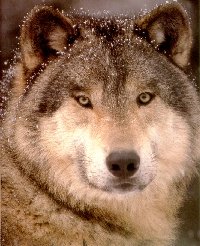
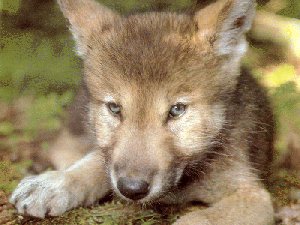
The gray wolf used to range throughout the U. S. Due to its predatory nature, it was seen as a threat to cattle. Many wolves were exterminated as part of government extermination programs aimed at protecting livestock. However, wolves were blamed for a lot more than they actually were responsible for. Wolves are now found in a few northern states, including parts of Minnesota, North Dakota, Montana, and the upper peninsula of Michigan. They live in Alaska and in most of Canada. The wolf is the largest wild canine in North America. Gray wolves can be gray, white, black or silvery. Some have facial markings that resemble those of huskies or malamutes. Gray wolves are also called timber wolves. They live in packs, although some animals will travel alone. Packs are nomadic and may range more than 250 miles. During the time when the alpha female has her pups in the den, the pack stays in one place. Other than that time, they are always on the move. Their primary prey include deer, moose, and caribou, although they frequently eat small mammals. Rodents form a major part of their diet. They will also eat various kinds of plants to get needed vitamins and minerals. Wolves have good hearing and a well developed sense of smell. This helps them find prey in their forested environment. Wolves have sharp eyesight. A wolf can run at 30 mph. When wolf packs hunt, they often set up ambushes to catch prey. They cull out weak or sick animals as they don’t have the speed to run down a healthy deer. The pack will charge a group of deer and quickly determine which is the weakest one. That is the animal they will try to catch. If a deer turns and fights, the wolf pack may move on to easier prey. Injury from a deer’s sharp hooves can lead to the death of a wolf. Wolf packs are territorial. If there is an abundance of prey, several packs may have overlapping territories. Each pack has a pair of leaders, known as the alpha pair. These are the only animals in the pack that breed. The pups are born between April and June. The average litter size is seven, but litters of up to 14 have been known. The entire pack helps feed and care for the pups. They bring food, which is then brought to the mother by the alpha male, the only other pack member who is allowed to approach the den. All pack members will take turns looking after the pups once they emerge from the den at about one month. Wolves are very social animals and have elaborate facial and body language displays that allow them to communicate to each other. The average life span of a wolf can be up to 18 years, but is more likely to be around 10 years. Wolves don’t hibernate in their dens. When the weather is bad, they may curl up in a ball and let snow drift over them to provide extra insulation. They sleep in the open as they don’t have many predators to fear. One member of the pack will stay alert and act as a sentinel to warn the others of danger.
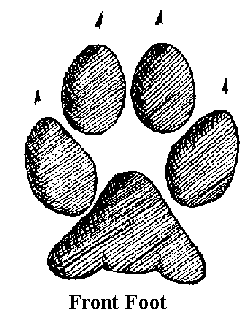
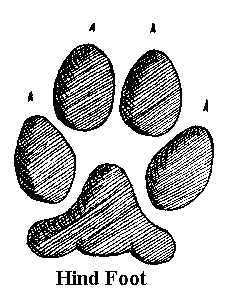
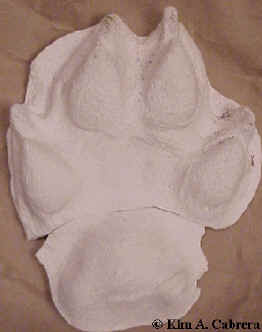
Wolf tracks, like those of all canids, show four toes on each foot with claw marks present. Wolf tracks are robust, often measuring 4¼ to 4¾ inches long. Wolf tracks can be difficult to distinguish from those of large dogs. The main difference is in habitat. Wolves are found farther from human habitation than dogs are. The stride of a wolf can be 26 to 30 inches. Wolves can run 30 to35 mph. At top running speed, the distance between groups of tracks can be six to eight feet.
|
|
|
Wolf scat will usually have the hair and bones of its prey. Scat can be 1½ to 2 inches in diameter. Some plant material may be present, such as grass or seeds. Wolves will mark their territory with scent markings. Scentposts on prominent landmarks tell other canids who is around. Wolves, as do most canids, use urine to mark the prominent landmarks. They also leave droppings in the middle of trails to advertise their presence. Canids will scrape near the scent deposit to spread the scent around and let other canids know whose territory they're in. Wolves and other animals, including bears and cougars, will cover partially eaten meat with dirt. You should never approach one of these camouflaged carcasses because the animal may not be far away. Bears and cougars will defend these partially eaten carcasses. Wolf packs may or may not, but it’s best not to take the chance. Wolves have a complex vocal communication system. They use yelps, whines, growls and body language to communicate amongst themselves. Posture is used to indicate the wolf’s position in the pack. Submission to a dominant pack member is indicated by a cowering stance and whining. The submissive wolf will lick the dominant wolf’s face. A wolf will growl, snarl, lay back its ears, and raise the hair on its back to let another wolf know to back off. Wolf howling serves as a communication between the entire pack. Wolves tend to give long howls instead of the yapping calls that coyotes are known for. When hunting, the pack will scatter out and use howls to keep in contact with each other. If a wolf finds prey or food, it will call the others with a special howl.
|
|
| The following collection of photos of wolf sign were donated by Dr. David Kowalewski | |
 |
|
| This is the scat of an adult gray wolf. | |
 |
|
| Cracks in a leg bone caused by a wolf chewing on it. Probably elk bone. | |
 |
|
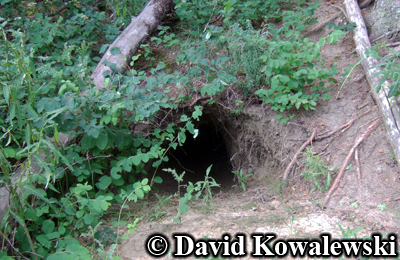
| A wolf den with two openings. | |
 |
|
| The entrance to another wolf den | |
 |
|
|
An active wolf den. The vegetation damage at the entrance is fresh, indicating recent use. |
|
 |
|
| Wolf den with alternate entrances | |
 |
|
| Overgrown wolf den entrance | |
 |
|
| Crawling in to map the inside of the den! | |
 |
|
| A student mapping wolf den architecture | |
 |
|
| Wolf den at the base of a fir tree | |
 |
|
| The view from a wolf den site by a meadow | |
 |
|
| Wolf den with a collection of debris at the entrance | |
 |
|
| Entrance to wolf "condo complex" | |
 |
|
| Den entrance near an observation post | |
 |
|
| Another den entrance | |
 |
|
| Unoccupied wolf den | |
 |
|
| Another unoccupied den site | |
 |
|
| View from one of the wolf dens of a meadow | |
 |
|
| Trees near one of the den sites | |
 |
|
| Wolf den under a spruce tree | |
 |
|
| Den under a horizontal root | |
 |
|
| Another den entrance | |
 |
|
|
Elk bones and feeding site. The matted down grass was caused by the feeding activity. |
|
 |
|
| Skull of an elk eaten by wolves | |
 |
|
| Leg bone of the elk cracked by wolf jaws | |
 |
|
| Another leg bone, showing cracks from the strong jaws of a wolf | |
 |
|
| Whitetail deer bones at wolf kill site | |
 |
|
| Tracking wolves with radio collars | |
 |
|
| Observing wolves from a distance so as not to disturb them | |
 |
|
| The view from a wolf's observation post | |
 |
|
| Perpendicular crack in leg bone | |
 |
|
| Wolf pup chew toy! | |
 |
|
| Bottle top chewed by wolf pups | |
 |
|
| Plastic tub chewed up by wolf pups | |
 |
|
| Wolf pup scat | |
 |
|
| Wolf run through tall grass | |
 |
|
| Whitetailed deer bones eaten by wolves | |
 |
|
| Another wolf run | |
 |
|
| Well-used run near rendezvous site | |
 |
|
| Wolf scat from the alpha male | |
 Gray Wolf