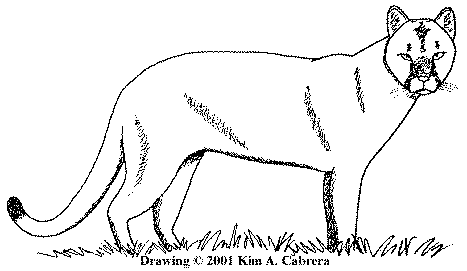
Mountain Lion (Cougar) 
Puma concolor

Cougar Tracks
Click here to hear a lion roar.
(26K WAV)


Natural History of Cougars 
|
Mountain lions are also called
cougars, panthers, catamounts, or pumas. These big cats have many common names. They are
the largest wild cats in North America. These solitary animals avoid people if they can. Their primary prey is deer, but they do eat porcupines, raccoons, birds, small mammals, foxes, mice, and grass. |
| The lion is a
magnificent animal which was hunted to near extinction and is now making a comeback. There
have even been reported mountain lion sightings in the eastern U.S., where they were once
thought extinct. A single male lion may require up to 175 square miles of territory for its home range. They prefer wild areas frequented by deer. One lion will consume about one deer per week. A lion will cover the remains of its prey and return to the kill to feed until the meat begins to turn. If you find a lion kill, don't hang around the area. The animal may still be nearby. An adult can weigh up to 200 pounds. Young mountain lions have spots and a ringed tail, and thus are sometimes mistaken for bobcats. (The bobcat has a short tail, while the lion has a long tail.) A litter of one to six young are born between late winter and mid-summer. The cubs stay with their mother for one or two years. |
|
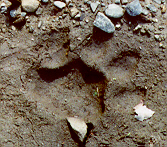
| Lion tracks show four toes on the
front foot and four toes on the hind foot. The retractable claws do not show in the
prints. Lion tracks can be over four inches long. They are good climbers and can leap more than 20 feet up into a tree from a standstill. They can jump to the ground from as high as 60 feet up a tree. A single male lion may travel 25 miles a night when hunting. Lions may be active by day in areas far from humans. They are most active at dawn and dusk, the times when deer are out feeding. |
|
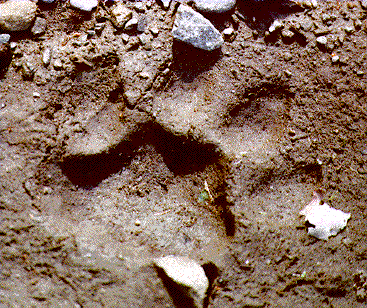
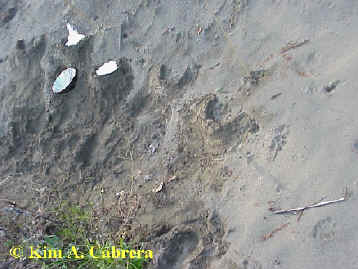
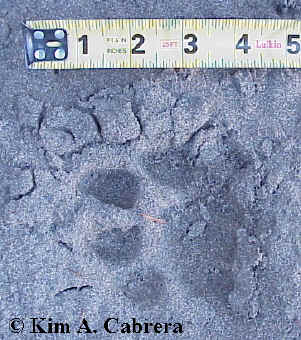
| Below is a lion track I found near Albee Creek Campground in Humboldt Redwoods State Park (California) in April, 1998. It was a good print in mud and I made a plaster cast of it. |
|
|
|
|
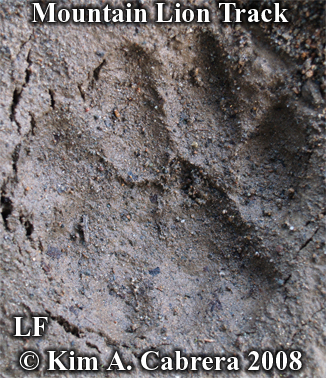
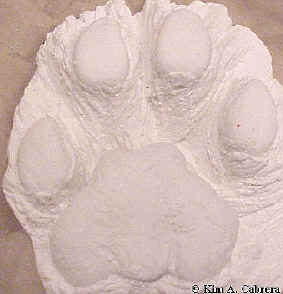
On the left is a mountain lion track cast in plaster of Paris. This cast shows all the details of the foot. It was cast from a mold. Casts made in the field are rarely this defined, and usually have soil stuck to them which cannot be removed without destroying details of the cast. This cast represents the right front foot. |
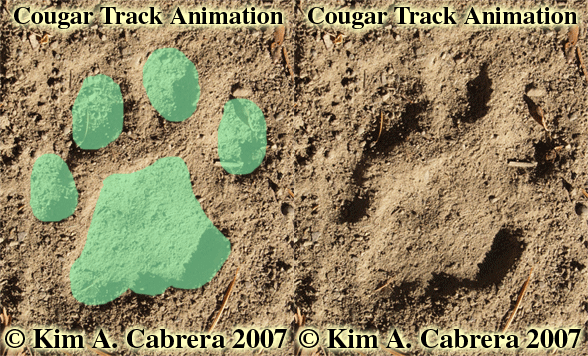
| This animation shows the outline of the
mountain lion track in the photo. You can see that the second toe from the
left (the inner toe) is further forward, making this the right foot. Also,
the shape of the heel pad will tell you this is the front track. For more on
how to do this, see the canine vs. feline
page.
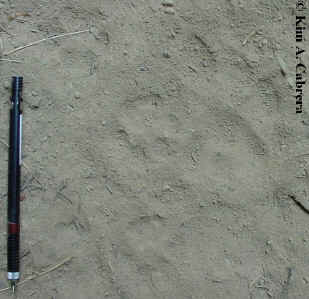
This track was found in a landfill area in Northern California in September 2007. |
|
|
|
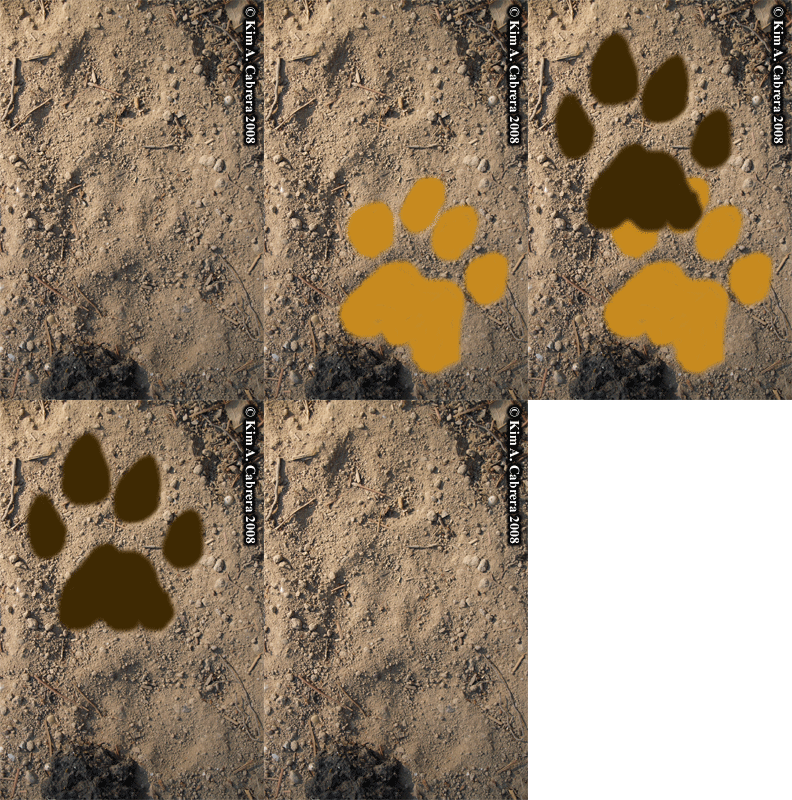
Another excellent cougar track with animation showing the track outlines. |
| Canine vs. Feline tracks (Is it a cat or a dog?) | |
| More Cougar Sounds | |
| Female cougar in heat sound (167KB WAV) | |
| Cougar purring sound (68KB WAV) | |
![]() |
|
| This young mountain lion was in a presentation by a rehab group. The red object it is chewing on it the handle of its leash. Young mountain lions have spotted coats, but lose that color as they grow older. | |
|
|
|
|
The beautiful mountain lion photos above are courtesy of Mike Schmitz. The lion was treed by his dog. Amazing photos! |
|

Personal Notes on Cougars
I have found cougar tracks many times. Many of the tracks belong to a young lion who has moved into one of my favorite tracking areas. I have heard many cougar stories from people who have lived in this area for many years. There is a town near here called Panther Gap, supposedly because of all the cougars that lived there when this area was first settled. (Dont bother looking on a map. Even on local maps, there is nothing to indicate Panther Gap. Its just too small.)
This lion can leap pretty high. I found tracks once where it leaped up onto a big redwood log from the ground. A pretty good leap from a standstill. Despite all the negative stories about cougars, I still enjoy finding their tracks. I saw my first lion in July, 1998. It ran across Highway 101 right in front of me. This was about four miles south of the town of Weott, California. It was a young lion.
In July 2002, I saw another mountain lion. This one was crossing the road near Elk Prairie Campground in Prairie Creek Redwoods State Park at 11p.m. The lion paused in the road, then sauntered off into the brush and disappeared. My friend and I gave each other "High Fives" because we were so happy to have seen one. I wished I had my flashlight handy so I could get out of the car and see more of the cougar. But we decided to leave it alone and continue our journey.
| Here's a cougar story that happened to me February 5, 1999:
|
|
| I went out exploring an old washed-out road this evening. The sun was low in the sky when I started out. I crossed a creek and continued up the old, overgrown road. In some places, there were washouts and slides. There was a place where there was actually some old asphalt, but the road had long-ago subsided, leaving little islands of asphalt atop pillars of soil protected from the rain by their asphalt caps. It was at the base of one of these asphalt-capped pillars of soil that I found the cougar tracks. The cat had jumped down from atop the pillar. There were several good prints in the soft soil. | |
|
|
| I followed these on up the road. I began to notice a lot of cougar scats in the road. Some were very old and scattered, and some newer. I kept an eye on the sun as it sank out of sight below the ridge. The road continued on and I wanted to see where it went. As it got darker, I decided this wasn't such a good idea after all. It had rained off and on yesterday and today and those tracks weren't really that old. So, I turned around and started back the way I had come up. I got past the spot where I first found the tracks and, in the fading light, saw something that got me moving a little quicker. There was a cougar print, a fresh one. The dirt at the edges had not even begun to dry yet and this track had not been rained on at all. It hadn't been there when I started up the road. Looking around at the sandstone bluffs above me, I searched in vain for a glimpse of the elusive tawny-coated critter. Sadly, I was not to see one this day. I turned and headed back home, disappointed not to have seen the cougar that had been following me. Maybe next time. | |
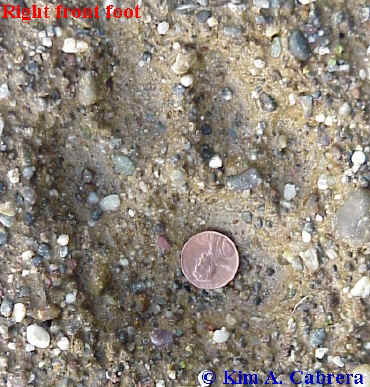
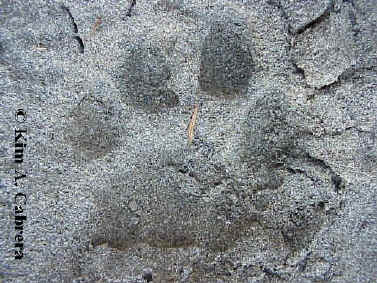
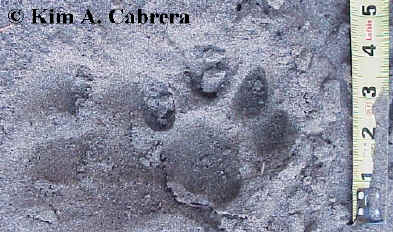
That's one big kitty! This is the right front foot. Notice how the second toe (from left) is farther ahead of the others? This toe is analogous to our index finger. Since the track is an imprint of the actual foot, that would make this the right foot. The large heel pad tells you it is the front foot. To see how a penny compares in size to a domestic cat track, visit the domestic cat page. A cougar track can be four inches long. Domestic cat tracks are usually only about an inch long. A penny is 3/4 inch wide. |
|
The Cougar on the Beach |
|
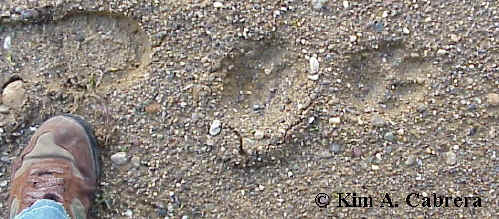
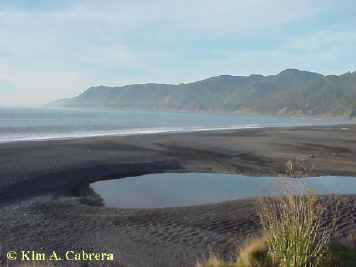
| The location of this track find - Black Sands Beach in the King Range National Conservation Area, Shelter Cove, California. Also known as the "Lost Coast." This wild stretch of coastline stretches north for over 30 miles. There are no roads, only trails. It is a great place to hike if you want to really get away from it all. It is the longest wild, undeveloped stretch of coastline in California. |
|
|
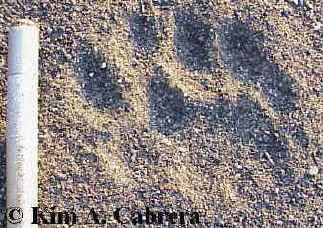
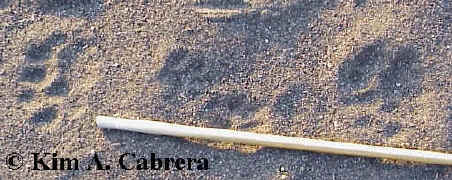
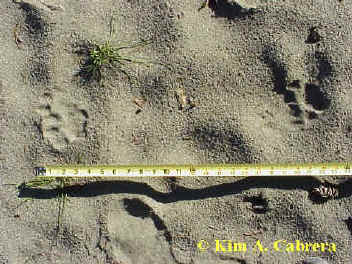
I was walking along the beach looking at and photographing skunk tracks and trail patterns when I turned around and saw the distinctive shape of this heel pad in the sand. The light was rapidly fading as the sun sunk below the horizon, so I quickly began photographing the mountain lion tracks. The lion had hopped down from a bluff and walked along the base of the bluff toward a freshwater creek that emptied onto the beach here. The track on top is the hind track. Size is about three inches. |
|
|
|
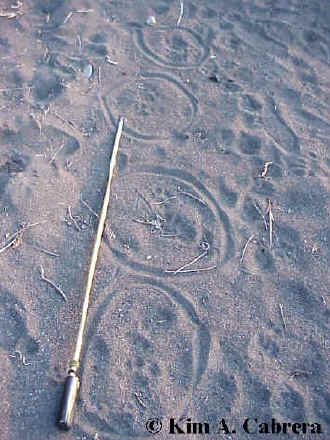
As I walked along, I circled the tracks just for fun. Who knows? Maybe someone
will come along and find them and wonder why they are circled. If they look closely, they
will probably see what kind of animal it was. I often wonder if anyone has ever found the
tracks that I sometimes draw circles around. It is my hope that they look a little more
closely at the tracks in the circle and maybe try to identify them. It's always good to
get more people interested in tracking. This is one way I try to generate interest.
Sometimes, I will even draw the name of the animal next to the circled tracks. The tracking stick in the photo is a little over three feet long. The stride is between 16 and 18 inches. It is always a special experience for me to find the tracks of this elusive creature. The experience is heightened by standing in a place where I know a big predator walked not too long ago as the sun sets and it gets dark. That's the time to saunter on home. |
The
Cougar that Visited Me |
|
| My next cougar tracking experience occurred less than a week after the Cougar on the Beach incident. I was exploring the river bar below my place when I again found the distinctive tracks of a cougar. This one had passed by within the last day or two. It was almost dark when I found the first set of tracks. I followed it along the river bar until it climbed up the bluff overlooking the river. I ran back home for some plaster of Paris. There was the possibility that it would rain overnight and I wanted to cast some of the excellent tracks I had found. I poured the plaster and waited. And waited... and waited ...as it got darker and darker. As I waited, I thought about how close this animal had been to my place. Had I been standing on the porch when it walked by, I would easily have seen it. I finally decided to go get a flashlight and lantern and a noise-maker. It was not a good place to be - out on the river bar alone at night when a cougar had been in the area not too long ago. I had no idea where it was at that moment, so it was best to go get some light. By the time I had hurried up the hill to get my lights, it was fully dark. I waited about 15 more minnutes to give the plaster a chance to dry, then headed out with my bright lights to pick up the tracks. I retrieved them and got home safely, but there still remained the rest of the trail. Where did it go? How far would I be able to follow the cat? I decided to try again after work the next day. This was winter, so it got dark around 5:30p.m. Luckily, the weekend was coming. But, if it rained before then, these beautiful tracks would be gone. | |
| The next day, I hurried home from work and grabbed some plaster and my camera. I was determined to follow this cat. I found the place where the cougar had climbed to the top of the bluff. Then, it had followed a trail at the top of the bluff that paralleled the river. This led to a grove of redwood trees. Behind the grove, the lion had climbed down the bluff to another river bar. There, the tracks were easily visible as the cat had walked across some nice flat sand. I found the best tracks yet and jumped up shouting, "Treasure!" They were almost perfect tracks. That yell alone was probably enough to scare the cougar off had it been anywhere near. |
|
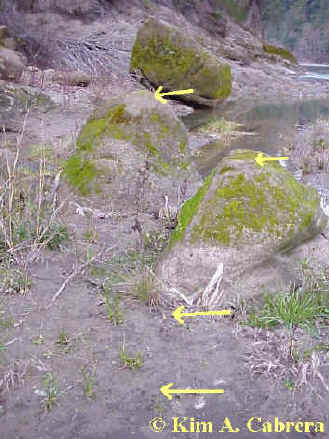
| By this time, I was pretty sure I knew where it was going. This might have been the same lion I had encountered in February 1999. (See story above.) It was heading for the mouth of the creek where it had been before. I'm fairly sure it spends most if its time up in that drainage. I followed the trail until I came to a jumble of rocks at the mouth of the creek. Here, the cat had jumped up on one rock, hopped to another, and hopped over the water to the sand on the other side. I stopped following here. It was again getting dark and I had to get back and take some photos. It was not supposed to rain and the next day was Saturday, so I planned to bring some plaster and return then. In the photo on the left, you can see the river on the right. The mouth of this creek is beyond the largest rock, behind the little mound of gravel. The arrows point to the places I found cougar tracks. It left some sand transfer on top of the two rocks it hopped on. The little backwater lagoon runs between the rocks and the sand on the other side, not visible in this photo. Two sets of tracks led up to the first rock. | |
| The stride varied from 18 to 20 inches when walking. This part of the trail followed open sand until it arrived at a small creek. Cats like to avoid obstacles like sticks, leaves and debris which can cause noise when stepped on. They are very careful about where they place their feet. Watch your pet cat walk sometime and you'll see how this works. | |
| The cat jumped over the small creek and landed in a sand dune. That was where I found the deepest and best tracks. This one of the prints from where it landed. | |
| The tracks along the edge of the sand dune. The location proved to be a difficult one to make castings on due to the slope of the dune. |
|
|
Here is how I overcame the problem of casting tracks on a slope. I built little sand walls to contain the plaster on the downhill side. I built up the walls high enough that the plaster could flow into all parts of the track. Some parts were deeper than others in the final cast, but at least I was able to make casts of them. Notice the walls prepared around the tracks I haven't cast yet. The plaster takes about 1/2 hour to dry. The trail continues off the lower right corner of the photo. I also found one set of bobcat tracks that crossed the mountain lion trail on this dune. |
| A real treasure - an almost-perfect mountain lion track. It is rare to see these animals, but finding their tracks is almost as good an experience as a sighting. |
|
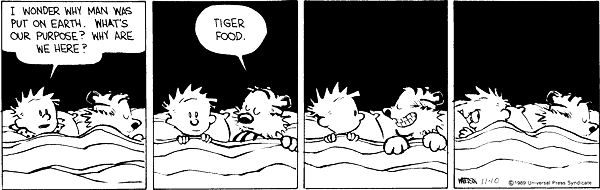
While tracking the cougar, I felt a little like Calvin must have felt above. Potential cougar food! |
|
The Cougar that
Stayed for a While |
| October 25, 2001 Thursday... I went for a walk today, just because I wanted to look for tracks on the sandy patch on the river bar. (Curiosity outweighed my need to keep my ears warm and not freeze them off on the windy river bar.) I had heard a strange noise last night long after dark. My cat, Tiger, was outside, as usual. He likes to stay outside, even at night. The others all come inside, but he refuses to do so. Even when it is cold. Well, last night, I heard a thump and what sounded like a hissing sound. Now, that usually means Tiger has encountered a raccoon or a skunk. He usually runs from the raccoons, hisses at the skunks. This was a big thump though and I immediately grabbed my flashlight and was out the door less than 10 seconds after I heard it. I saw nothing, although Tiger was not at his usual post on the porch. He doesn't go far from the source of his food. I called him several times and waited a few minutes. I looked under the cabin and looked for tracks, thinking all the while of the night Bones was dragged off by the bobcat. Finally, he came trotting down the hillside. He was way up there for some reason. Something had scared him off. I couldn't see any tracks out there, so I figured he had made the thump when he jumped off the boards under the cabin. I didn't think anything more about it until I was walking along the river bar and happened to decide to go up the big river access trail. I had been down by the water and had found the sand patch torn up and some black and white clumps of fur scattered about. It looked like something had attacked a skunk and torn out pieces of its tail fur. I headed up the gravel and got to the bottom of the access trail where a shape caught my eye. Two tracks side-by-side, worn by the wind until the edges were rounded. They were unmistakable. Not a bobcat... too big for that. Mountain lion. A young one too. Eagerly, I took photos of them and then followed them backward. I wanted to see where the lion had come from. I found tracks here and there in patches of sand interspersed with rocks as I went toward Redway beach. I found where the lion had come down the rock on the southern part of the camp property. I stopped there and decided to follow it the other direction and see where he had gone. It was dusk and the sun had long ago gone behind the ridge. It would be too dark soon. The wind had kicked up a bit and was rustling the leaves enough to cause me to keep looking back over my shoulder. I went back to the river access trail where I had first picked up the trail. Following along, I found tracks going in both directions. There was an area where the lion appeared to have stayed for a while because there were numerous tracks. I got near a log that had been washed up by the river and had since overgrown with berry vines. There, I stopped to examine some scat that may be porcupine scat. Then I noticed the smell. It smelled like something was dead nearby. Ick! I moved on rather than crash into the brush to examine what might be the mountain lion's food cache. Perhaps Tiger had heard something last night. Maybe he heard the cat kill a skunk? I found another place not too far away where the cat's tracks were crisscrossing each other. It had spent some time here. Looking up, I saw the window of my cabin about 100 feet away through the trees. This summer, the maintenance guy had cut some trees here and it is now very easy to see most of the camp from the river. Had I been looking out that window last night, I would have seen the lion. The tracks showed no rain pock marks. In sheltered places, the tracks looked almost fresh. In unprotected areas, the wind had worked on them and flattened some out until only the shape remained. But they were no more than a day old. One of them had some lizard tracks inside, in the heel mark left by the cougar. I found one nearly perfect track. The light was almost gone, but I tried to take a picture anyway. I hope it comes out. I then stacked a few rocks around this track, hoping to protect it from the wind so I can come back tomorrow with better light and get another photo. I followed the trail on. At the smaller river access trail, where I had come down, I found more tracks. I had been focused earlier on getting to the sand patch because I had seen ravens there and wanted photos of their tracks. Had I looked at my feet, I would have found much more exciting tracks. The cat had paused here too, perhaps considering whether to go up that trail, or continue on the river bar. It apparently decided on the latter because the trail led north on the river bar, toward where I had seen lion tracks last January. This one followed the same path. It could have even been the same lion. I didn't go up the hillside to see if it had climbed up there. The light was fading fast and there wasn't time. I headed back and stopped to examine a pair of shoes and a shirt that was laying on the rocks. This hadn't been here several weeks ago. Maybe the lion ate the shoes' owner? Time to get outta here! I hurried back to the trail and on up to camp, checking the trail for telltale tracks. There were none. A raccoon had gone down the trail to the river, but no lion had come up that way. There were numerous tracks from my cats on the sandy trail. Tomorrow, I think I will go to the place where I found the lion tracks in January at "Effluent Creek." If I am correct, he will have gone that way and up into the drainage of Leggett Creek. In a way, I want it to come back, although I worry about Tiger. He refuses to come inside, or to come near enough so I can grab him and bring him inside. But, I want to hear a mountain lion scream. I have been told what it sounds like, but never had the privilege of experiencing it for myself. I want to hear that sound that is supposed to send shivers up your spine and make you glance nervously at the locks on the doors and the shadows under the trees. Of course, I don't want to be on an empty river bar in the dark when I hear it..... October 26, 2001 The mountain lion tracks I had found yesterday had proved too enticing to ignore. So, earache or no, I had to go back and see what the story was. The river bar was already in full shadow as the sun had just dipped below the ridgeline. The first place I went was where I had placed rocks around the most perfect track I had found yesterday. There, I stopped to move the rocks aside. The track had been protected from the wind and was still in good shape. I took numerous photos of it from different angles, with and without a penny for scale. Then I moved on looking for more tracks. I got several more photos. Soon, I ended up at the place where I had first detected that smell yesterday. I sniffed around and looked at the vegetation. There were some trampled areas and broken branches. I decided to go on in. Cautiously, of course. There were numerous deer trails in there and I took what appeared to be the most heavily used one. Under an old rotting alder branch, I found some sawdust and chunks of wood. Thinking I might be following a porcupine, I looked up to find where the material had come from. There, staring me in the face, was a pair of gaping holes left by a pileated woodpecker. I have been hearing one calling near here for several weeks. It had chosen a good place. The hole was on the underside of a branch where it would be sheltered from the rain. How do animals know such things? I came to a place where I smelled the familiar scent very strongly. I moved in through the brush. There was a wider trail here, much wider than a normal deer trail. Bear? I continued on and found a place where an animal had laid down, matting the grass down in an oval shape. The trail led back toward the camp. I was right underneath the parking area near the dumpster. Suddenly, I saw something ahead. It was a dark form resting in some matted down grass. It wasnt moving, so I contined my approach. As I drew closer, the first thing that hit me was the smell. I had found the source. I took photos as I approached. It was a doe. She had been killed with a bite to the back of the neck. There were marks in the grass where the carcass had been dragged. The hunter had begun to consume the prey from the hindquarters. The bones appeared to be all there, save a few ribs that had been eaten. This kill had not been abandoned very long. The other animals would have scattered the bones. I believe those mountain lion tracks I found yesterday were made that morning or late that night. This kill was probably abandoned around the same time. I had followed the tracks yesterday to the north end of the river bar. I didnt get a chance today to follow them further to see if they ended up where the ones in January had. This find took precedence over trailing the lion to the mouth of the creek. I took numerous photos from all angles. I got close-ups of the hooves and feet. I then backtracked to the scene of the actual kill. It was not far away. The lion had briefly chased the deer, then killed it. There was torn-up vegetation. There had been a little struggle, but not much. The lion had then dragged the carcass under a log and out into the patch of grass on the other side. It had then spent quite a long time laying next to its kill, feeding when it was hungry. The grass was matted down in a big circle around the carcass. It had probably been there for several days. There was little meat left for the scavengers. I kicked myself for not seeing the lion that was all of 150 feet from my door! It will be interesting over the next few days to watch the behavior of the turkey vultures and ravens. I wonder how long it will take until the bones are picked clean. The skunks and raccoons and foxes will probably join in as well. I took the trail up to camp. This new trail comes out by the clothesline. There, I noticed something I had seen when I hung up laundry two days ago. A mound of dirt scraped together. I had noted it in passing several days ago. Now I looked a little closer. There, near the mound, was a cougar print. And the mound itself contained cougar scat. A scrape pile! Territorial marking! I looked up. My truck was parked not 30 feet away. I guess that ends any trips to the clothesline to retrieve my laundry after dark. I will have to pay attention and remember to bring in the laundry before dark from now on. Just in case. October 28, 2001 I spent half the day today tracking the mountain lion. I first went to the north end of the property and found that it had indeed followed the same route back to the creek drainage as it, or another lion, had taken in January. I found only the one set of tracks there, headed back to the creek. So I went back to the scene of the first tracks I had found below the lodge. I returned to where the kill was to check on the scavengers' progress. They had been busy and had dragged the carcass about ten feet. Most of the bones have been picked clean, but there is still more left for the really desperate scavengers. The tracks there told me that two coyotes had been there. I then followed a well-worn path up the embankment toward the camp. I found a place up there where the lion had laid down. The vegetation was matted down in a circle. It had a perfect view of the cascass below. It probably went up there after eating its fill just to sleep it off. Just as my cats do. The thing is, I looked up and there was the clothesline about 20 feet away. There was my car about 20 feet beyond that. There was my window not too far from there. This lion had lain there when I was walking around not 50 feet from it. I know I had done laundry during that time, and had hung it on those lines. In fact, there was some hung there now. I found several tawny, stiff hairs snagged on berry vines where the lion had walked through to get to the open space by the clothesline. So, that scat mound I found there did belong to this cat. I took a photo from the cat's eye view of my place. Very interesting what he could see from there. And kinda scary in a way. I definitely won't be making trips to the clothesline after dark anymore. I cut off a short berry vine that had a lot of hair snagged on it. I am going to tape the hairs in a notebook or something to keep them. Not every day that a big kitty visits you so close. I found a total of four places where the cat laid down to nap and digest his meal. I also found several exits he had used to get to the river from the brush where he was spending so much time. I looked all over, but didn't find any more scent mounds or scat. I walked around the dirt parking area, looking for coyote tracks. I found them. Two coyotes. They had briefly harassed a deer right near where I park. I followed the tracks and found them coming down the road. They had been there before I got home last night. I got home really late. Their tracks were under, or partially under, the incoming vehicle tracks I had made late last night. The other scavengers who have been hanging aorund are the ravens and turkey vultures. The ravens are much more noisy about their activities than the vultures are though. I hear them over there near the site of the carcass in the morning. So many critters to track. So little time. When you think about how many animals are out there, and that each has four feet, that's a lot of tracks. All just waiting for me to come along and find them.... Tracking is the only really fun thing to do. If I didn't recognize those tracks as mountain lion tracks, I wouldn't have found all this and would have been totally oblivious to the story that was played out so close to home. A brief glimpse into the life of a cougar. One more reason to learn how to track anything that moves.... |
More Cougar Track Photos |
|
|
Cougar track in shade, illuminated by the reflection from a camping mirror. This technique allows you to control your light source and makes subtle tracks stand out from the surrounding soil. Hold the light as close to the ground as possible to create an oblique angle. This makes good shadows in the track itself. This is the left hind foot. |
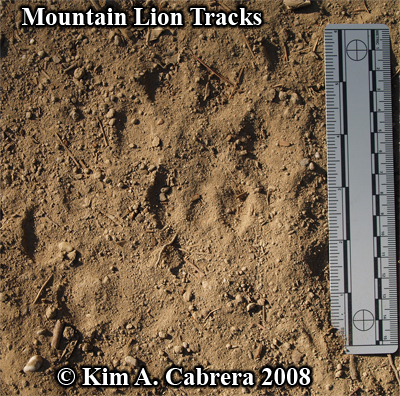
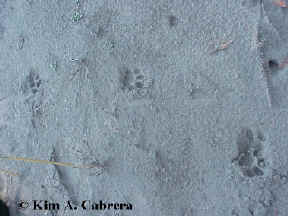
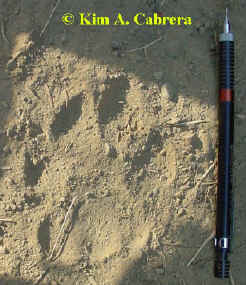
| Two cougar tracks overlapping on a dusty dirt road in Humboldt Redwoods State Park. Direction of travel in the photo is from right to left. The full track on top is the right hind print. | |
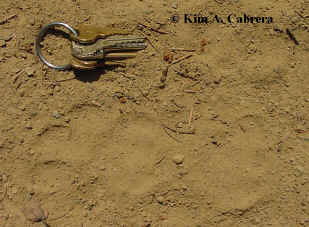
| Three bobcat tracks and two cougar tracks on a dusty backcountry road at Humboldt Redwoods State Park, California. Photo taken in August 2002. Bull Creek Fire Road, south of junction with Kemp Fire Road. The cougar was walking toward the top of the photo and the bobcat was going the opposite direction. Notice the size difference between the tracks of the two species. | |
| Cougar paw in a Visitor Center display at Humboldt Redwoods State Park, California. The characteristics of a cat track are visible here. The leading toe indicates that this is the left foot. The shape of the heel pad indicates it is the front foot. Two lobes on the leading edge and three on the hind edge of the heel pad further help to identify it as a cat track. |
|
|
|
A nice cougar track in snow. Photo from Minnesota, by Jim Forsberg. Thanks! |
| Another beautiful cougar track in snow. This photo and the one below are courtesy of Robert Means. Thank you! |
|
|
|
A pair of cougar tracks in snow. This photo and the one above are courtesy of Robert Means. Thank you! |
|
|
|
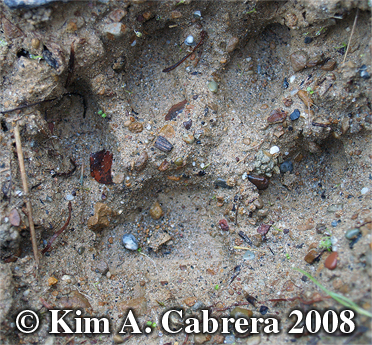
| The cast on the left was made from the track on the right. This is a left front foot. The toes were splayed due to the terrain the mountain lion walked on. It had walked over a small mound of dirt on the side of a newly constructed dirt road. It had then rained 8 inches before I found the track. For having so much rain on it, it was in very good condition. This track was located in an area I call The Wasteland. It's a landfill where sludge from a water treatment plant is buried. People don't go there much, except to bury more sludge, so the animals have the place all to themselves. I've found black bear, mountain lion (cougar), bobcat, gray fox, skunk, and many more species there. The photo above right was taken near dusk, using the flash on the camera. It was too dark to get a good exposure. I had walked into the area and cast some excellent bobcat prints and was waiting for the casting material to dry. I found the cougar track as it was getting dark, so I came back the next day with more material to make the cast. The casting material used here is called Traxtone. It's harder than plaster of Paris once it dries and cures for about a month. It's also very expensive, so I only use it for tracks in good condition. | |
|
|
The track on the left was the same track as in the photo above right. I took a photo when I went back the second day, prior to making the cast. I had better light that day. Notice that one of the two forward toes is aligned ahead of the other. This will help you identify left from right on mountain lion tracks. This is the left front foot. |
Find mountain lion and cougar tracks posters, greeting cards, postage stamps and more in my new store.
|
Now available: "Animals Don't Cover
Their Tracks - An Introduction to Animal Tracking" on CD! (Version 3.0)
New drawings, more species, more photos, more extensive sections on tracking
humans, more detailed directions for plaster casting, mystery tracks section,
tracking stories section, and more. The CD features over 100 species, including
special bonus sections with the tracks of some African and Australian
animals. A large section on tracking lost people for search and rescue is
included, with over four pages of photos showing the details of tracks and
signs people leave. Easy to use format. This web site is limited
by bandwidth, but the CD-ROM is not. The CD is available in my online store at:
www.dirt-time.com
Works with Mac or PC. Happy tracking!!
What else can you find in the nature store? Beartracker's animal tracks coloring book, T-shirts, sweatshirts, journals, book bags, toddler and infant apparel, mouse pads, posters, postcards, coffee mugs, travel mugs, clocks, Frisbees, bumper stickers, hats, stickers, and many more items. All with tracks or paw prints, or nature scenes. Custom products are available. If you don't see the track you want on the product you want, email me and I can probably create it. Proceeds from all sales go to pay the monthly fees for this web site. You can help support this site as well as get great tracking products! Thank you! |
| Find other tracking products: www.zazzle.com/tracker8459* |
| Also visit these fine
stores for more products of interest: NDN Pride shop - For Indian Pride items for all tribes. Custom items available on request. ASL Signs of Love - For anyone who uses or is learning ASL, American Sign Language. Custom name items and more are available here. Sales from all stores give commissions to Beartracker's Animal Tracks Den, which helps keep this site online as a free service. We are celebrating ten years online this year! |
|
If you wish to help keep this site online, donations are
accepted through PayPal. |
|
||
![]() |
Got a cougar story? E-mail me and tell me about it. You are visitor number:
|
![]() |
|
||
Copyright © 1999-2008. Kim A. Cabrera - Desert Moon Design.
Page updated: Saturday, January 19, 2008.