 Domestic Cat
 Domestic Cat
Felis catus (formerly Felis domesticus)
 |
 |
| Left front
(Size: 1 1/2 in. L X 1 3/8 in. W) |
Right front
(Size: 1 1/2 in. L X 1 3/8 in. W) |
 |
 |
| Left hind
(Size: 1 5/16 in. L X 1 3/8 in. W) |
Right hind
(Size: 1 5/16 in. L X 1 3/8 in. W) |

Domestic Cat Track

Natural History of Domestic
Cats
|
|
Cat
tracks show four toes on the front foot and four toes
on the hind foot. Cats do not show their claws in
their tracks because they are retractable. (More
technically, this is called protractible. This means
that the normal relaxed state of the toe muscles has
the claws sheathed. When the muscles contract, the
claws come out of the sheaths.) Cats, unlike dogs,
keep their claws sharp by not walking on them. The two
front toes in a cat track are not aligned right next
to each other. The inner toe is set further out than
the outer toe of the pair.
When we think of cats, we usually think of pets. However, there are many feral domestic cats running around. They can live singly or in colonies of cats. Cats are usually nocturnal, or active at night. They will get up early in the morning and have a "play time." (My cats always do this when I'm trying to sleep.) Afternoon is nap time. Play can consist of pouncing on toys, on other cats, on leaves, or any other moving object. Some cat play is actually practice for hunting. |
| Female cats are good hunters. This is because
they feed the young. Cats are ambush predators. They
don't chase down their prey in long chases. They tend
to lie in wait or stalk their prey and pounce on it.
They eat small mammals, birds, and anything else they
can catch. Prey is killed with a bite to the back of
the neck. Female cats will bring live prey back to
young to teach them how to catch it.
The feet of a cat show their hunting style. They have large, soft pads on the front and hind feet. These cushion each step and make their movements quieter. claws are carried sheathed so that they don't normally scrape on the ground as the cat moves. A cat walks in a way that sometimes leaves a hind track on top of a front print. This is a way of moving silently through the landscape. When a front foot is placed down and doesn't snap a twig or otherwise make noise, the cat can move the hind foot to that same spot and know that it will be taking a quiet step. Cats hunt by lying in wait and jumping on their prey. They do not chase down their prey like canids do, so their claws can remain retracted and kept sharp for catching and holding prey. Canids need their claws out to gain traction when they chase prey. Cats have sheathed claws (retractable). Keeping the claws sheathed until they need them helps keep them sharp. Dogs walk on their claws all the time and the claws get dull as the dog ages. However, a wild canine's hunting strategy is different. They chase down their prey over long distances. Cats rely on stealth and ambush in catching prey. Their claws must be sharp and ready when they need them. Cats are territorial and have a variety of methods for marking their territory. They will spray urine on objects, scratch trees and posts, rub their faces on things, and leave scat, or droppings, as a marker to let other cats know whose territory they are in. Male cats do more spraying than females do, although females do sometimes spray. If a cat feels threatened by the presence of a new cat, it may go out and re-mark its territory. Scratching trees and upright objects is a way for a cat to display its size to other cats. The higher the scratches, the bigger the cat. When a cat rubs on something, scent glands on the side of the face leave behind odors for other cats to find. House cats do this a lot, even rubbing their faces on their owners to mark them. Cats will also butt heads in displays of affection for one another. Domestic cats bury their scat, but wild cats will sometimes leave it exposed as a way of claiming territory. Cat scat is in segments and is somewhat blunt on the ends. Cats can breed any time of the year, and a single pair of cats can produce two or more litters a year. The mother cat will keep the kittens hidden until they are about five or six weeks old. |
|
|
|
|
|
A nice clear cat track in mud. Fine silty mud is great for showing detail. |
|
|
|
|
| A pair of cat tracks overlapped. Hind track is on top of front in this photo. The fur on the bottoms of the feet is visible in this photo. This particular cat has lots of fur on the bottoms of his feet, even in summer. | |
|
|
|
| This looks like a cat with five toes, however it is actually an overlapping pair of tracks. The hind print is on top of the front and almost perfectly covers it. The fur on the bottoms of the feet is visible in this photo. This particular cat has lots of fur on the bottoms of his feet, even in summer. | |
|
|
|
| This domestic cat buried his scat in a neat circular fashion before departing to the right. The ruler is six inches for scale. | |
|
|
|
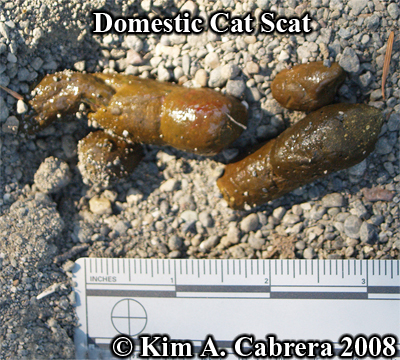
| A fresh scat deposited by a domestic cat. The scats of domestic cats appear similar to those of wild cats, such as bobcats. The contents differ in that many domestic cats eat kibble instead of wild prey. | |
|
|
|
|
A nice domestic cat print in drying mud. |
|
|
|
|
| Boots, the cat, and his handiwork. He was scratching at the upright log that his paw is resting on in the photo. The claw marks he left are visible. Look for scratch marks on logs, fence posts and other wooden objects wherever there are domestic cats. Birds also use this log as a perch as evidenced by the small scat clinging to the tip. | |
|
|
|
| This nearly perfect cat track was almost obliterated when I stepped on it. Luckily, I saw it and moved my foot in time. I only managed to step on the edge of the heel pad. This track shows very nice definition of the toes, as well as the shape of the leading edge of the heel pad. | |
|
|
|
| A perfect track left by Boots, the cat, in mud. His paws have a lot of fur on the bottoms and some fur marks are visible in this track. | |
|
|
|
| Domestic cat tracks found on a car trunk. Cats love to climb up on cars. I used to have a neighborhood cat that would hop up on the hood of the car and sleep over the warm engine. Cats do love to be warm. | |
|
|
|
| Boots, the cat, burying his scat. Cats are very neat creatures. Burying scat may be related to being stealthy predators and trying to hide their presence from the prey animals. However, many wild cats do not bury their scat. Domestic cats seem to do it more than bobcats do. | |
|
|
|
|
This is what the buried scat looks like after the cat is done. Boots did a good job here burying his scat. |
|
|
|
|
|
Bones, my pet cat, approaching a bobcat scat at the river. Domestic cats seem to know the scats of their larger cousins, the bobcats. I have watched her ignore coyote scats and those of gray foxes as well. But she will investigate those of bobcats. |
|
|
|
|
|
Cats rely on scents for many things. Scats and urine are used for marking among felines. Bones, the cat, spent several moments in her examination of this bobcat scat. I have noticed the boundaries that my cats will stay within change as they explore and find scats and urine markings from the wild cats that live in their home. |
|
 |
|
| Domestic cat track in mud. | |
 |
|
| Same domestic cat track as above, after a rain. | |
 |
|
| Pair of domestic cat tracks in mud. Right hind at top and right front at bottom. | |
 |
|
| Pair of domestic cat tracks in mud along a river. | |
 |
|
|
A nice pair of
overlapping cat tracks made by Boots. His feet are
very furry, as you can tell by the fur marks in
these pawprints. The print appears to have five
toes, but that is because it is actually two prints,
one on top of the other. The front track was made
first, then the hind foot stepped in that track,
making what appears to be one large footprint. Some
cats do have more than four toes on their feet. This
is called polydactylism. See below for an
explanation. |
|
 |
|
| Domestic cats
use tree trunks, posts, and other objects (like your
couch) as scratch posts |
|
 |
|
| Domestic cat
scratch post, this one with a rather ominous
decoration - feathers! |
|
Canine vs. Feline tracks (Is it a cat or a dog?)
|
So, why does my cat have five toes? (or more) |
| Domestic cats have
a fifth toe, with a claw, located higher up the
"wrist," which does not usually leave am imprint in
the tracks. This claw is called the "killer claw" and
is sometimes used in hunting. There is also a sixth
pad located even higher up the "wrist" that lacks a
claw. Very rarely will you find either of these
imprints in the tracks. If you do find them, it is
usually because the animal is running. Take a look at
the photo below of Junior's foot and you will see both
of these structures. (Check the Bobcat
page to see a photo of a bobcat track showing these
features.) I don't know what function the sixth toe
has, other than just being there. The fifth is used to
help grip prey. Since cats lack an opposable thumb, it
could possibly serve a similar purpose to them. If you
do find these imprints in a track, look for other
clues as to what the animal was doing. Sometimes you
will find them where cats have been playing in damp
sand, or running in mud.
There is also another phenomenon which could account for a cat track showing more than four toes. This is called polydactilism. Occasionally, a cat is born with five or six toes on all its feet, plus the "killer claw" and extra pad on the "wrist." This growth of extra toes happens frequently in populations of feral cats, and is also something that cats are bred for. Apparently, it doesn't affect their ability to survive. I once owned a six-toed cat. I now wish I had taken photos of its tracks! There are cats with four to seven toes on a foot! The current world record for a polydactyl cat is 27 toes!!!! |
|
|
|
|
|
|
| I have had many cats as pets. As any cat owner will say, they are great to have around. Not only do they catch mice, they have some amusing antics too. Most of my cats have been feral cats that I've tried to tame. (In fact, all except one were obtained this way.) Sometimes it works, sometimes it doesn't. By getting feral cats altered, then releasing them, the population of wild cats can be held somewhat in check. | |
| The fine mud in this photo shows the details of the hair on the bottom of the cat's foot. Mud like this tends to be sticky. That is why the patches of mud stuck to the cat's toe and heel pads and were picked up with the foot. If you find tracks like this, look at the next few tracks and you may find where the mud has fallen off. When tracking humans, the mud that falls off a shoe often contains the pattern from the sole. This can be used to positively identify a track. |  |
 |
At the top of the page is a fresh cat track, made by my cat, Bones. (Short for Skin-and-Bones. She used to be very skinny.) This is the right front foot. You can tell which foot it is by looking at the placement of the two front toes. One of them is a bit farther ahead of the other. That is the inside toe. Also, this track has a wider, more robust heel pad than the hind foot has. That tells you this is the front foot. Take a look at your cat's feet sometime and you will see that the four feet are not all alike. |
|
Scratches made by a domestic cat digging. The purpose of the digging here was unclear. It was not to bury scat. Perhaps this cat, like some wild cats, was trying to scrape together a mound of debris to mark territory. |
 |
|
|
This is the left front foot of a domestic cat. (NOTE: No cats were harmed to obtain this photo. My cat was sleeping when I snuck up on him and took the picture. See photo below.) The heel pad on the front foot (called the metacarpal pad) is larger than that of the hind foot. Front feet are generally larger than hind feet on many animals, including cats and dogs. The fifth 'toe' located further up on the left of the wrist does have a claw and it is used in hunting. This is called the "killer claw." (AKA the dewclaw, or toe #1) Often it is assumed that cats only have four claws on their feet, but they actually do use this claw when hunting. Bobcats and mountain lions also have this extra claw. The pad on the right, furthest from the toes, is just a pad without a claw. It is called the carpal pad, named for the bone which is underneath it. Cat hind feet do not have any extra pads or claws, just the four toes with their claws. |
| This is Junior the cat. He is the offspring of Bones the cat. He gladly allowed me to take a picture of his foot to show the structure of the pads. (Actually, he didn't even know I did it. He was sound asleep in the warmth of the heater at the time.) Looks comfy, doesn't he? Cats spend incredible amounts of time napping. |
|
|
|
|
|
|
|
|
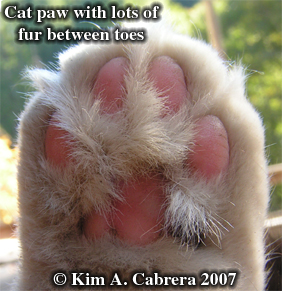
Cats' paws often have a lot of fur on the bottoms. This helps keep their toes warm in winter. |
|
|
|
|
| The parts of a cat's foot.
A is the carpal pad. B is the dewclaw, also called the
"killer claw" because they use it to grasp prey. C is
the heel pad or metacarpal pad. The toes are not
labeled in this photo. The toes are called the digital
pads because they are the cat's digits, just like our
human fingers are our digits. There are five toes on
the front foot, including the dewclaw. However, only
four usually show up in the tracks. The toes are
numbered from one to five, with the dewclaw being toe
number one. Thanks to Bones for letting me photograph
her foot.
Fat deposits underneath the skin on the cat's pads act as shock absorbers for jumping and landing. |
|
|
|
This excellent domestic cat track shows all the details. The claw marks show, which is unusual. This track was made while jumping, so the toes are splayed, the claws registered, and you can see both the dewclaw pad and carpal pad imprints. This is the right front footprint. There is even a tiny white hair stuck to the left inner toe print. This track was made by my cat, Bones, who has white fur on her feet. |
|
|
|
| This photo shows a lot of mouse activity. These numerous tracks were found near the entrance to a culvert. There was a lot of mouse activity going on within 20 feet of this location as well. I had my cat along on this walk and he jumped down into the culvert opening and left the two cat tracks seen above. Predator and prey in one photo. The cat tracks can be difficult to see at first, but look closely. Look for compressed areas where there is a lack of mouse sign. | |
|
|
|
All photos Copyright © 1999, 2007, 2012 by Kim A. Cabrera
Find cat and kitten posters, greeting cards, postage stamps and more in my new store.
|
Visit Beartracker's Nature Store
online store at: www.dirt-time.com
Happy tracking!!
What else can you find in the nature store? Beartracker's animal tracks coloring book, T-shirts, sweatshirts, journals, book bags, toddler and infant apparel, mouse pads, posters, postcards, coffee mugs, travel mugs, clocks, Frisbees, bumper stickers, hats, stickers, and many more items. All with tracks or paw prints, or nature scenes. Custom products are available. If you don't see the track you want on the product you want, email me and I can probably create it. Proceeds from all sales go to pay the monthly fees for this web site. You can help support this site as well as get great tracking products! Thank you! |
| Find other tracking products: www.zazzle.com/tracker8459* |
| Also
visit these fine stores for more products of
interest:
NDN Pride shop - For Indian Pride items for all tribes. Custom items available on request. ASL Signs of Love - For anyone who uses or is learning ASL, American Sign Language. Custom name items and more are available here. Get Every Child Outdoors (Get E.C.O.) - My shop dedicated to nature and getting kids interested in nature and the outdoors. Sales from all stores give commissions to Beartracker's Animal Tracks Den, which helps keep this site online as a free service. We are celebrating ten years online this year! |
|
If you wish to help keep this site
online, donations are accepted through PayPal. |

 |
Got a cat tracking story? You are visitor number: Photos, drawings, and text copyright © 1999, 2018. By Kim A. Cabrera |
|
Page updated: Saturday, March 17, 2018.
© Kim A. Cabrera - Desert Moon Design






 since February 10, 1999.