 |
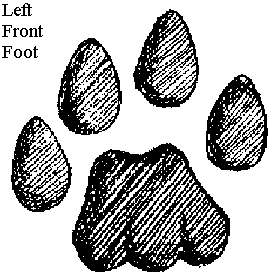
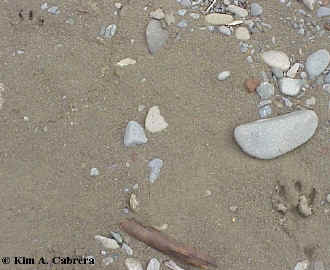
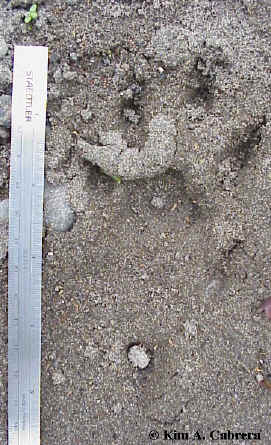
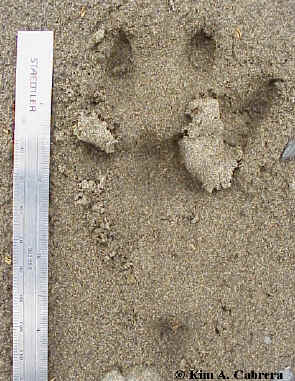
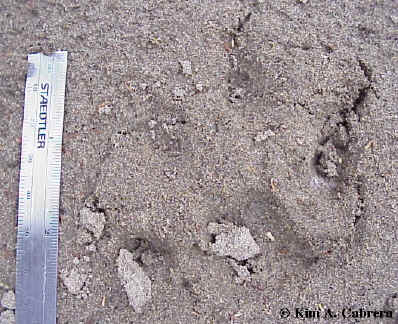
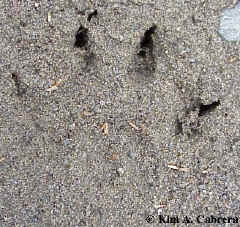
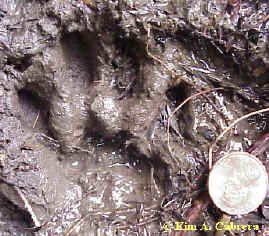
Bobcat tracks show four toes on the front
foot and four toes on the hind foot. Cats rarely show their
claws in their tracks because they are retractable.
Cats, unlike dogs, keep their claws sharp by not
walking on them.
Bobcats are active
any time. They are seen in the daytime, but do a
lot of hunting at night. They hunt small mammals,
such as mice and squirrels, but can take an animal
as large as a deer. Bobcats are shy animals and
are not often seen by humans. They can range up to
50 miles a day while hunting, but usually hunt
within an area of four to five square miles. They
hunt from the ground, but will pounce on prey from
trees.
|
| Bobcat young are born in
April or May. The average is three kittens per
litter. They are born blind and stay with their
mother until fall.
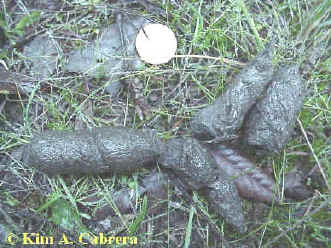
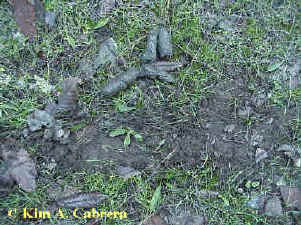
Bobcat scat is in
segments and usually contains the hair and bones
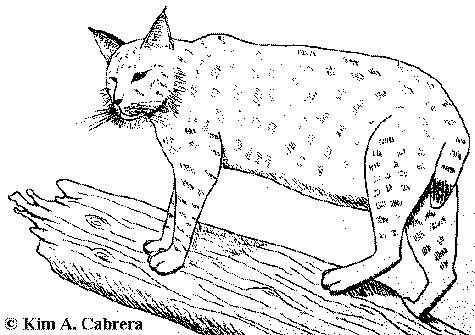
of its prey. Bobcats get up to about 30 pounds.
They have short tails (six to seven inches long),
while mountain lions have long ones. The end of
the tail is black, tipped with white. The body is
covered with spots, which can vary between dark
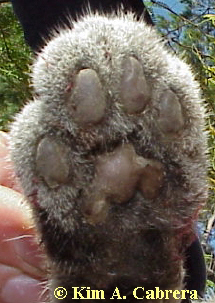
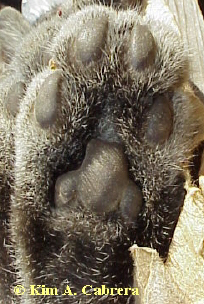
and light. The feet have large, soft pads that
help them move quietly while stalking prey. The
backs of the ears have white spots on them.
|
|
|
| |
|
 |
| This bobcat was resting in some brush and
tall grass at the edge of an open field. It had
a great view of the entire field and any prey animals
that happened to pass by. This field is habitat for
jackrabbits, cottontails, deer, voles, and other small
rodents that are easy prey for a bobcat. I first saw
the outline of the bobcat's head and ears from about
halfway across the field. I slowly and quietly walked
toward it, being careful not to move suddenly and
scare it. The bobcat was aware of me the entire time
and just watched me approach. They rely on their
camouflage to blend in and hide their presence. The
bobcat didn't move until I was about 20 feet away. At
that point, it got uncomfortable and decided to
quietly sneak off into deeper brush. It moved
soundlessly, carefully placing its feet so as not to
step on any leaves or twigs. It stopped to look back
at me a couple times and make sure I was not
following. I just watched and took photos of it. It
was an amazing animal and so stealthy! The paws are
made for stealth, with large pads on the heels and
claws that retract so as not to make any noise. You
can browse the bobcat track photos below to see what
their footprints look like.
|
|
To see more photos
of the bobcat, visit the Bobcat Photos Page
or
the Bobcat
Sighting Page.
For more bobcat
track photos, visit the Bobcat Track Photo
Gallery:
Page 1
| Page
2 | Page 3
| Page 4
| Page 5
Bobcat Scat Identification
Pages:
Bobcat
Scat Pg. 1 | Bobcat
Scat Pg. 2 | Bobcat
Scrapes
Bobcat Videos from Trail
Cameras
Bobcat and Black Bear Scent Marking a Tree
|
| |
|
|

|

|
|
Right hind bobcat track
in dust.
|
Pair of bobcat tracks
in dust.
|
| |
|
 |
|
Bobcat (left) and deer
(right) tracks in soil on a recently graded road.
Predator and prey may not have been here at the same
time. Both were heading the same direction. The
direction of travel is from right to left in the
photo.
|
| |
|
 |
|
A comparison of the track
of a bobcat (left) and a dog (right). The dog track
shows a slip due to the speed at which the animal
was moving as well as the muddy surface it stepped
in. Both of these tracks have aged a bit. They are
not fresh. They were found in a drying mud puddle.
|
| |
 |
|
Another comparison. This
one shows the track of a coyote next to the tracks
of a bobcat. side-by-side comparisons of tracks of
different species are useful to trackers learning
how to tell them apart.
|
| |
 |
|
A close-up of the bobcat
track seen above. This is a nicely detailed track
and you can see the signs that it has been submerged
in the puddle as well. This is the left front foot.
|
| |
| |
|
 |
|
Another sign of bobcat
presence - a scrape made by a bobcat. This
particular bobcat made over a dozen of these in a
trail approximately a mile long. This is a form of
territorial marking. The bobcat also deposited
several scats along this same route. Bobcats will
often deposit urine on top of their scrapes.
Sometimes, you will find scats in them too.
|
| |
 |
A beautiful left front
track in mud. This is a fine track, with all the
details. Tracks like this are rare and make trackers
very happy! The outer edge of the metacarpal pad is
longer then the inner edge. There is a leading toe,
which is toe number 3.
|
| |
 |
|
Another fine left front
track. This is the same foot as in the above photo.
Notice how no two tracks are alike, even made by the
same foot on the same animal. This is what makes
tracking so much fun.
|
| |
 |
|
A nice bobcat track in
fine dust on the edge of a dirt road. This bobcat
had followed the road for about a mile and a half. I
happened upon the tracks when they were only hours
old and followed them. It gets more challenging to
track on dirt roads after a number of vehicles have
driven over them. The extra dust helps to obliterate
tracks, so it's best to get to these roads early in
the day to find the best tracks! This track
illustrates how bobcat tracks can, at times,
resemble dog or fox tracks. However, examination of
the trail led to the identification as bobcat. This
is why making a "single track identification" is
never a good idea. It's always best to use all the
clues and signs available to you. Follow the trail
for a few steps if you find a track like this and
make sure of your identification.
|
| |
 |
|
Another nice bobcat track
from the same bobcat that I followed down the dirt
road. This track shows very good details, but is
showing age and accumulation of dust in the print.
Is this a left or right print? Hint: Look for the
leading toe. In this case, it is a right
print.
|
| |
 |
|
A wonderful left front
bobcat track. This mud held clear details and even
showed where some sand had clung to the toes. Some
of the sand was deposited on the edge of the print.
Bobcat tracks are a joy to look at!
|
| |
 |
|
A set of overlapping
bobcat tracks. Single, perfect tracks like the one
above this photo are not the usual finds. Often, you
will find overlapping or partial prints like those
above.
|
| |
 |
|
It was dark when I
attempted to get this photo, so I had to use the
flash. This is not the ideal way to photograph
tracks, but it worked well in this case. This is a
nicely detailed right front foot.
|
| |
 |
| Another set of bobcat
tracks illustrating the appearance of overlapping
prints. |
| |
 |
|
This bobcat track shows a
lot of distortion caused when the animal slipped in
the mud. The toes are not really that long! If you
were trying to identify this track from just this
photo, you could be misled. This is why it's best to
have more clues to base an identification on. Follow
the trail for a ways and see if you can find other
tracks, or more details that would help identify it.
|
| |
 |
|
A clear bobcat trail on a
recently graded road surface. Two animals passed
this way and you can see where their tracks got
close together briefly.
|
| |
| |
 |
Beautiful perfect
bobcat track in snow. Found near Reno, NV. The bobcat
was visiting a haystack to hunt rabbits that visit the
haystack to eat hay. Donated photo. Left front
foot.
|
|

|
|
Beautiful perfect bobcat
track in snow. Found near Reno, NV. The bobcat was
visiting a haystack to hunt rabbits that visit the
haystack to eat hay. Donated photo. Left front foot.
|
|

|
Bobcat trail in snow. Found near
Reno, NV. Light snow shows nice clear prints.
Donated photo.
|
| |
|
|

|

|
| Variations in the appearance of bobcat
tracks. These tracks were from the same animal and
laid down in the same track sequence. Variations of
terrain led to the tracks looking distorted.
|
| |
|
|

|

|
| The casting on the left was made from the
track shown on the right. This print was nearly
perfect and the cast shows many details that are
difficult to see in the actual track without proper
lighting. Using a flashlight held at a low angle would
allow the tracker to control the light source and
bring out many details that are not easy to see with
just sunlight for illumination. The cast is the
"positive" image and the track itself is the
"negative." The track is from the right front foot.
(RF) The green material used to cast the print is
called Traxtone. It is stronger than plaster of Paris,
but much more expensive. |
| |
|
|

|
This
bobcat track resembles a gray fox track. The alignment
of the leading toe and the heel pad shape, as well as
the lack of claw marks, help identify it as bobcat.
On the bobcat's hind feet, the toes are oriented more
in an arc than those of the front foot. On the front
foot, the toes wrap around the metacarpal pad neatly.
The hind track of a bobcat can look more dog-like.
|
| |
|
| Bobcat track in dust. |

|
| |
|
|

|
This pair of
bobcat tracks found at the side of a dirt road was
very fresh when found, but it was too dark to
photograph them. These photos were taken when they
were one day old. |
| |
|
|

|

|
| There
are three bobcat tracks in this photo. One is a front
track partially obliterated by the hind track. |
This
bobcat track was fairly fresh. It still had nice crisp
edges and hadn't been rounded off by the wind. |
| |
|
|

|

|
| A bobcat scat found on a dirt road. The photo
on the right shows where it was placed on the road.
This is a common placement for a bobcat. Apparently,
depositing a scat in the middle of a road is a marker
for other animals to find and read. |
| |
|
|

|

|
| The bobcat scat (above left) was very fresh
when found on a dirt road in early morning. There were
nice bobcat tracks in the dust next to it, but no
scrape mark. The photo above right shows the placement
of the scat on the road. Bobcats will often deposit
scat at trail intersections, or in the middle of a
dirt road or trail. A dog walking on this road several
days later caught the scent of the scat after it had
walked past it. It stopped, sniffed the air, and
turned around and went right to the scat, which it
spent several minutes sniffing. So this an effective
manner of communication among animals. |
|
|
|
|

|

|
| Bobcat scats. Bobcat scats are usually
segmented, but not always. Their digestive system is
very efficient, so the hair and bones are often almost
completely digested by the time they are eliminated in
scats. There is often a grayish material in them that
becomes more obvious as they dry out. Sometimes, they
dry out into white scats too. Bobcat scats are usually
firm if you poke them with a stick, because the
contents are tightly packed by the bobcat's digestive
system. |
| |
|
 |
| Bobcat scat found at the top of a slope on a
trail. This scat was deposited on a rock outcrop that
forms part of the trail. It is the highest point on
the trail. See photo below. |
| |
|
 |
| The arrow points to the location where the
scat in the photo above this one was deposited. The
bobcat walked along the dirt trail, leaving nice
tracks. When it got to the tallest point, the top of
this rock, it deposited a scat there. Location is
everything to wild predators. |
| |
|
|

|
Very fresh
bobcat scat. |
| |
|
|

|

|
|

|
Three bobcat scats,
above, above left, and left. The scat above is very
fresh, having been deposited only minutes before I
took the photo.The bobcat was seen departing up the
road.
|
| |
|
|
This bobcat scat shows the classic
segmented appearance. Not all scats look so textbook
perfect. Scats vary with the animal's diet and the
moisture content of food, etc. Even scats from the
same animal won't always appear with the same
consistency, color, contents, or firmness.
|

|
| |
|
|

|
A
bobcat scat found on a dirt road. This was relatively
fresh. I had driven home on this road less than an
hour before I hiked it and found this scat. There were
clear bobcat tracks in the dust next to it. The cat
had walked down the road and had not been in a hurry.
|
| |
|
 |
| A latrine site used by
several species. The bobcat scat on the left was the
first deposit. A raccoon deposited the scat on the
upper right, then a gray fox left the one on the lower
right. This latrine was found where two dirt roads met
in a mixed oak forest. One of the dirt roads is rarely
used. |
| |
|
 |
|
This latrine site
contained five bobcat scats. They were all of
various ages. This location was on an abandoned dirt
road, where an animal trail crossed. There was dense
brush on either side of the road, with the animal
trail being obvious. The location was a mixed forest
of pine, oak, redwood and Douglas fir.
|
| |
|
 |
A very fresh bobcat scat
found on my road. There were bobcat tracks, as well as
raccoon tracks.
The tracks indicated that the raccoon had walked over
to check out the bobcat scat, then moved on. |
| |
 |
| A close-up of the scat
above. It contained fur from prey as well as
bloodmeal. |
| |
 |
| The photo above shows
the location where this scat was found. Bobcats will
frequently deposit their scats in the middle of roads
and trails in this area. To the right, just off the
road, is a pond. I once took a photo of a bobcat at
that pond. I have seen several bobcats crossing the
road near here as well. This is very good bobcat
habitat, with plenty of rabbits, squirrels, and
rodents to hunt. |
| |
| |
 |
| The scat above was found
on the top of a rock outcrop that overlooks a trail.
This is the highest point in the area and the bobcat
deposited the scat in the most prominent point. This
behavior is a way of marking territory. The scat's
location in the middle of a trail in a highly visible
location assures that other animals will notice it and
examine it. Scat is thus used by many species as a
means of communication. |
| |
 |
| An overview photo
showing the location of the scat deposit above. This
rock outcrop overlooks the river to the right and the
trail below. |
| |
 |
| A bobcat scat in a
scrape. The scrape area covers about 18 inches, with
the scat being deposited in the middle. Bobcats will
often leave scrapes like this, with or without scats
in them. |
| |
 |
| A close-up of the bobcat
scat found in the above scrape. |
| |
| |
 |
|
This right front track of
a bobcat was found on the edge of a dirt road. The
edges don't receive as much traffic as the middle of
the road, thus the powdery fine dust builds up deep
here. This is one is the best places to find nice
tracks like this one.
|
| |
 |
|
Another pair of nice
bobcat tracks in deep dust at the edge of a dirt
road. Trackers are
always looking in places like these for tracks. Each
season has its benefits to the tracker. Summer
provides this fine dust. Winter provides mud and
snow.
|
| |
| |
|
|

|
A nice track
in very deep dust. The details of the print are easily
identifiable as feline in this photo. |
| |
|
|
A rare perfect bobcat
track. Nicely formed tracks like this that show all
the details are not what you usually find. A find
like this is exciting to a tracker.
|

|
| |
|
|

|
|
Side view of a bobcat
skull from a private collection.
|
| |
|
 |
| Front view of a bobcat
skull from a private collection. Check out those
canine teeth! |
| |
 |
|
Boots, the domestic cat,
investigates a bobcat scat on a trail. Boots often
follows me when I go walking near home. This scat
was on a trail above the river. Boots sniffs at all
the bobcat scats he comes across. I have noticed,
however, that he tends to ignore the coyote scats.
Perhaps there is something to this. Interspecies
scats don't interest him, but those of other felines
to.
|
| |
 |
|
Boots, the domestic cat,
investigating another bobcat scat. This scat was
located at the top of a rock outcrop on a trail
above the river. A very prominent placement that
almost assures that other cats who pass this
location will see it and come to investigate.
|
| |
 |
|
Boots, the domestic cat,
investigating a location where a bobcat sprayed on a
bush. Bobcats will spray like this along their
trails, but this is a sign that is invisible to
humans unless there is snow on the ground, or you go
over and sniff the bush yourself. Boots located this
one for me.
|
| |
 |
|
Bones, my pet cat,
approaching a bobcat scat at the river. Domestic
cats seem to know the scats of their larger cousins,
the bobcats. I have watched her ignore coyote scats
and those of gray foxes as well. But she will
investigate those of bobcats.
|
| |
 |
|
Cats rely on scents for
many things. Scats and urine are used for marking
among felines. Bones, the cat, spent several moments
in her examination of this bobcat scat. I have
noticed the boundaries that my cats will stay within
change as they explore and find scats and urine
markings from the wild cats that live in their home.
|
| |
 |
|
A nice pair of bobcat
tracks in mud. These tracks could be confused with
gray fox tracks. However, following the trail that
led to them there were other tracks that were
clearly bobcat. Trackers shouldn't rely on "single
track identification." It's best to follow the trail
a bit if you have tracks that resemble those of
another species. Confirm what species it is by
finding other tracks.
|
| |
 |
| A nice casting made from a
beautiful bobcat track. Notice the details of the heel
pad. The three parts to the hind edge and the two
parts to the front edge. Notice also the alignment of
the toes, with one toe leading the other. These are
all cat characteristics. |
| |