| |
|

|
|
 Personal Notes on
Black-tailed Deer Personal Notes on
Black-tailed Deer
|
| There is a high
population of deer here where I live on the northern
coast of California. I see them feeding along the busy
highway, in pastures with the cattle, in orchards, and
everywhere on the property I caretake. I've seen them
out feeding in the rain and even lying down to rest in
the open when its raining. They seem oblivious to it.
Whenever I arrive home after dark, I see the deer in
the field near my place. Their eyes reflect my
flashlight beam and show up as two bright dots in the
darkness. It's always fun to see the does with their
new fawns. |
 |
| |
|
|

|

Young doe feeding in an apple orchard - Cuneo
Creek Campground, Humboldt Redwoods State Park,
California
|
| |
|
| This fawn was seen along with two others
following its mother along Bull Creek in Humboldt
Redwoods State Park, California. It is unusual for a
doe to have three fawns. The usual number is one or
two. |

|
| |
|
|

|
A small fawn with spots on its coat.
The doe and this fawn's twin were on the other side of
the fence. The little fawn was trying to figure out
how to get to the other side. |
| |
|
|
An older fawn that was
grazing with a doe and a yearling in some tall
grass.
|
 |
| |
|
|

|
The same fawn when it looked directly
at the camera! |
| |
|
| This older fawn was attempting to
nurse. The doe tolerated this behavior for a minute
and then just simply walked away. The fawn got the
idea and went back to food more appropriate for its
age. |

|
| |
|
|

|
Deer feeding signs. These
acorns were cracked open by deer. The animals take
the acorn between their teeth and grind it open.
They manipulate the opened acorn with the tongue to
get the nut out. They spit out the shells and eat
the nut.
|
| |
|
| Why are they called blacktailed deer?
Well, have a look at the tail of this one. :) |

|
| |
|
|

|

|
|
A doe and her fawn
feeding on blackberry leaves.
|
| |
|
|

|

|
| Even though they are commonly called
"spike horn," deer do not have horns. They have
antlers. The difference is that antlers fall off each
year and horns to not. |
The ground here was torn up by a buck
in the rut. The mating season for deer is in the fall,
when the bucks have their antlers. You will find
plants torn up in similar fashion. |
| |
|
|

|

|
| Clustered form of deer scat. The
moisture content and the type of food can affect the
appearance of the scats produced. |
This doe stood on her hind legs to
reach the best parts of the plant she was eating.
Blackberries! |
| |
|

|
|
Typical deer scats are pellets.
|
| |
|

|
|
Deer scat in pellet
form.
|
| |
|
|

|
Some deer scats found on a gravel
river bar. The river had been near flood stage earlier
in the week. These scats were deposited after the
water receded. |
| |
|
 |
|
Deer scats in dry grass. These are summer scats and
very compact. Less moisture in the diet makes the
pellets hold their form well. |
| |
|
|

|
A deer track in dried mud. |
| |
|
|

|

|
| A handsome four-point
blacktailed deer buck. This buck was following around
a small doe in the evening. The doe would run a little
way, then stop to try to feed. The buck was not far
behind and kept on chasing her. The fall is rutting
season for blacktailed deer. |
| |
|
|

|
A close-up showing deer scat. You can
clearly see the small dimple on one end of the scats.
The other end is often somewhat pointed. |
| |
|
 |
|
Doe and fawn peering over a rise.
|
| |
|
|

|
This buck is rub-urinating. The bucks
do this during the rutting season. They rub their hock
glands together, then urinate on them. This makes a
scent marker that lets other bucks know whose
territory they are in. Bucks will also thrash
vegetation with their antlers and rub on trees. |
| |
|
| A doe urinating. In contrast to the
buck above, who urinated directly on the glands on his
hind legs, the doe is not marking scent. |

|
| |
|
|

|
These two deer walked across the Eel
River. However, their first act upon entering the
water was to both urinate in the river. I think this
is a way of hiding scent. Deer, being prey, must be
careful to hide their presence from predators. While
predators will mark frequently with scent in their
territory, it would likely not serve prey species well
to do so. They must hide from predators. Urinating in
the river probably is a good way to hide scent. This
was the first time I had seen this done, however, I
have observed other deer doing this in other locations
since then. |
| |
|
 |
 |
| During
rutting season, bucks rub their antlers on trees and
saplings, causing damage. |
 |
 |
| These willows were along a river
edge. The buck seemed to have rubbed on all the bigger
willows. |
| |
|
 |
 |
|
A small Douglas fir
sapling with a small scar, and a tan oak tree with
fresh scars, and old scars, from bucks rubbing their
antlers.
|
| |
|
 |
 |
| A small sapling with a
rub mark. |
This deer track shows
a lot of action. The front hooves splayed out and left
a long mark when the animal slipped in the mud. The
two dewclaw marks show how the slip was stopped. |
| |
|
 |
A buck with velvet on
his antlers. This is early in the season.
|
| |
|
 |
 |
|
These photos show the
same buck. The left was taken November 11, 2006. The
right was taken on December 21, 2006. They are of
the same buck. On the left, he is in the prime of
the rutting season and has lots of energy. At right,
he is at the end of the rutting season and is
exhausted. Bucks spend a lot of time following the
does around and expend a lot of energy. They don't
eat as much during this time. At the end of the
season, they are very tired. The buck on the right
was just laying in the grass, trying to sleep, and
getting rained on. He was gone the next morning, but
he allowed me to approach quite closely for the
photo.
|
| |
|
 |
| Two fuzzy fawns in early fall.
|
| |
 |
|
There are four fawns
around this doe. They are not all hers though. What
happened was the doe who was the mother of two of
these fawns got locked on the wrong side of a fence.
Her fawns were stuck on the other side, trying to
get to their mother so they could nurse. They were
hungry! So, when the second doe and her two fawns
showed up, the other fawns immediately ran to her
and started bleating to be fed. She sniffed at them
and would not feed them. Then she chased them off.
She is a really skinny doe and likely didn't have
any extra milk to give the other fawns.
|
| |
| |
 |
|
These acorns shells were
all that was left after deer fed on the nuts. The
deer take the acorn and use their teeth to crack the
shell, then use the tongue to maneuver the nut out.
The shell is spit out.
|
| |
|
|

|
Deer scats in river gravel. These
scats show the typical form with a point on one end.
|
| |
|
 |
|
Four Columbian blacktailed deer in
tall grass.
|
| |
|
 |
|
A buck with velvet
antlers eating an apple in a campground. This
campground is located in an old apple orchard and
many animals feed on the bounty at the end of
summer, when the fruit falls from the trees.
|
| |
|
| |
|
| |
|
|
|
|
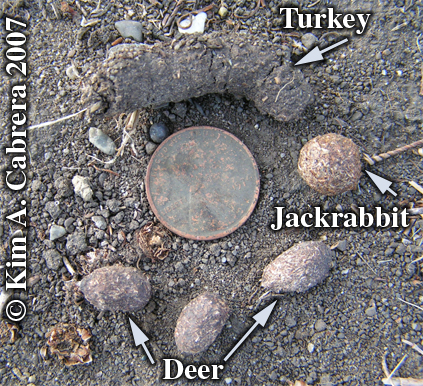
Deer scats compared to
those of other herbivores often found in the same
environment.
|
| |
|
|

|
A beautiful track in mud. This was on
a dirt road that had been recently graded, so the soil
was nice and flat. |
| |
|
 |
| A
beautiful deer track in fine dust. |
| |
|
 |
|
This is the typical
overlapping trail of a deer. The hind track is on
top of the front track. Deer have sharp hooves,
which they can use to defend themselves. My cat was
once chased by a mother deer who perceived him as a
threat to her fawn.
|
| |
|
 |
|
This hind track had
nearly perfect register on top of the front track.
Many deer tracks overlap. You have to look closely
to see it sometimes.
|
| |
|
 |
| Another
pair of overlapping deer tracks. Notice that only the
edges of the hooves left imprints in this muddy
surface. |
| |
|
| Deer track showing splay of the toes
caused by a running gait. The direction of travel is
to the right in this photo.
Hind foot.
|

|
| |
|
|

|
Another deer track with toes splayed.
This is a front track. You can tell by
looking at the position of the dewclaws. The
dewclaws on the front feet are angled away from the
foot. The dewclaws on the hind feet are set at a
more parallel angle.
|
| |
|
 |
| Deer track
showing the dewclaws. These are often mistaken for
buck tracks. The reason for this is that bucks
frequently leave tracks like this during the rutting
season. When they follow the does, they sometimes
lower their head and walk like that. This leaves
tracks that show the dewclaws because the feet are
supporting the weight of the head and antlers at a
lower than normal angle. So, there is some truth to
the tale that these are buck tracks, but the rule of
thumb is that they are not ALL buck tracks. Examine
the trail carefully for other identifying features
before making a determination.
This is the hind track. You can tell
by looking at the orientation of the dewclaws. The
dewclaws on the hind feet are oriented fairly
parallel with the hooves and the direction of
travel. Those on the front feet are angled outward.
|
| |
|
|

|

|
| A doe and her twin fawns
cross a dirt road. Does can have either one or two
fawns at a time. Three fawns is rare, but does
occasionally happen. |
| |
|
|

|
A doe and her fawn emerge from the
brush and cross a dirt road. |
| |
|
 |
| A small
fawn entering the brush. |
| |
|

|
| A young fawn crossing a
meadow. This one had another fawn with it, as well as
two does. The does walked ahead and behind the two
fawns, who stayed in the middle. This method of travel
must be a way for the adult deer to protect their
young from predators. This fawn is about two months
old. |
| |
 |
| A fawn
licks the head of a doe. |
| |
 |
| Family of
blacktailed deer. |
| |
 |
|
Family of blacktailed deer. Notice how
skinny the doe is. This is common for late summer.
When acorns fall in the autumn, they fatten up by
eating them.
|
| |
 |
| Blacktailed deer scats in pellet
form. Scat shape and consistency can vary depending on
diet. |
| |
| |
 |
|
This doe was feeding on
acorns in early fall. The late summer diet of
berries changes as the crops change. Few berries are
available this time of year, so the deer switch to
the newest crop, which happens to be acorns. These
nuts are very rich in nutrients and help the deer
gain back some of the weight they lose when they
raise fawns all summer.
|
| |
 |
|
Doe under an oak tree.
During fall, the deer tend to spend a lot of time
foraging under the trees where they find nutritious
acorns. This one spent most of the morning and
afternoon under this same tree. Why expend the
energy to go to another tree when there are plenty
of acorns right there? Animals need all the energy
they can get to make it through the lean winter
months.
|
| |
 |
|
This doe was curious
about hikers on the trail below her. She peeked
around the tree and gave them a look, then went back
to feeding. In parks, many animals become accustomed
to the presence of people.
|
| |
 |
| A young
fawn with fading spots was feeding along the river. |
| |
 |
|
This fawn was resting
at the edge of a meadow. Deer like to find places to
rest where they have a view of their surroundings.
This helps them stay aware of predators.
|
| |
 |
|
Often, this is the only
view you will get of a deer as it bounds away from
you. Sometimes they can be skittish and run off at
the approach of people.
|
| |
| |
 |
|
The teeth of a deer are
large and relatively flat on top. This helps them
grind up their food. Some foods, such as acorns, can
be very tough and these are the perfect type
of teeth needed to break them apart.
|
| |
 |
|
Side view of a deer
skull found along the river. Deer lack top incisor
teeth, but have excellent grinding teeth on the
sides.
|
| |
 |
|
The mortality rate of
young deer can be high, depending on the number of
predators in the area. In this case, a yearling was
killed by coyotes. Coyotes tend to drag parts of the
skeleton all over the place, rather than feeding in
one location. Several days after this photo was
taken, the remains disappeared, likely moved off
into the brush so the bones could be opened for the
marrow. Animals in nature do not waste anything,
especially a food source.
|
| |
 |
|
Eye shine from a deer
at night. Using a flash on the camera, or a
flashlight, will allow you to see the eyes shining
back at you.
|
| |
 |
| The eyes
of a deer shining in the light of a camera flash.
|
| |
 |
| Blacktailed
deer doe in front of spring flowers - lupine. |


